When a radiator starts playing up — cold spots, leaks, banging noises — the question most homeowners ask first is: “Do I need a new one, or can this be fixed?”
The answer depends on the specific fault, the age of the radiator, and whether the issue is in the radiator itself or the central heating system it’s connected to.
This guide walks through the most common radiator problems, which can be repaired, and when replacement is the smarter call.
Common Radiator Faults and What They Mean
Most radiator problems fall into one of these categories. Understanding which one you’re dealing with makes it much easier to decide on the right approach.
Cold at the top, warm at the bottom
This is almost always trapped air in the radiator. Air accumulates at the top and prevents hot water from filling the whole panel. Bleeding the radiator with a bleed key releases the air and usually fixes the problem within minutes.
If the same radiator needs bleeding repeatedly — every few weeks — there’s either a system leak bringing air in, or a problem with the system’s automatic air vent. This needs investigation rather than repeated bleeding.
Cold at the bottom, warm at the top
This is typically sludge — a build-up of corroded metal particles and debris that settles at the bottom of the radiator and blocks hot water flow. You may also notice brown or dirty water when you bleed the radiator.
A sludged radiator can sometimes be removed and flushed individually. If the problem is widespread across multiple radiators, a full system power flush is usually the better solution.
Radiator leaking
Leaks come from different places and indicate different problems:
- Leak from a valve — usually fixable by tightening the gland nut or replacing the valve
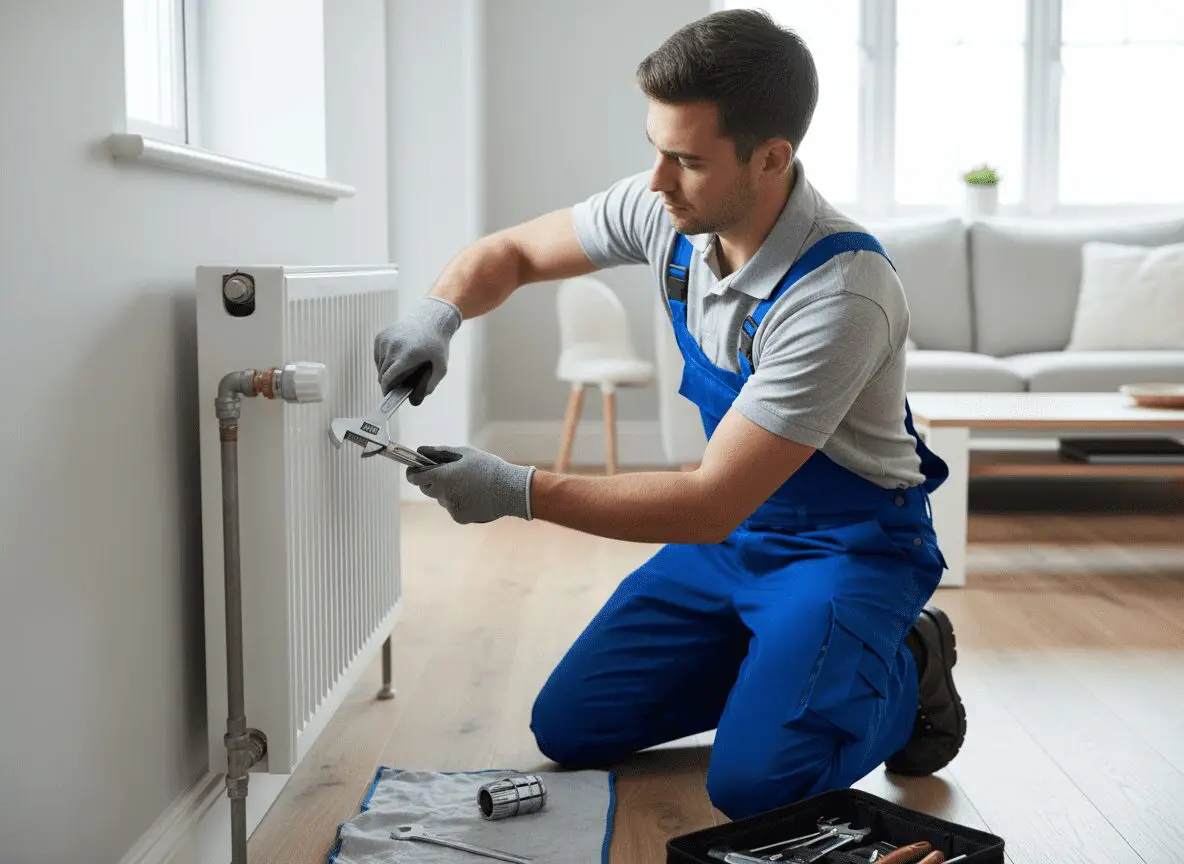
- Leak from a pipe connection at the radiator — typically fixable by remaking the joint
- Leak from the radiator body itself — a pinhole or crack in the panel usually means replacement is needed
Banging, gurgling, or ticking noises
Banging and ticking from radiators is often related to thermal expansion — the metal expanding and contracting as it heats and cools. This can be reduced by lowering the system temperature slightly or adjusting brackets.
Persistent gurgling suggests trapped air or a flow issue. Loud knocking may indicate a pump problem or water hammer in the pipework — this should be investigated by an engineer.
Radiator doesn’t heat up at all
If one radiator stays cold while others work fine, the thermostatic radiator valve (TRV) is the most common cause — the pin inside gets stuck in the closed position, especially after summer when the heating hasn’t been used. In many cases this can be freed without replacing the valve.
If multiple radiators are cold or the whole system is struggling, the problem is more likely in the boiler, pump, or system balance rather than in the radiators themselves.
Faults That Can Usually Be Repaired
These radiator problems are generally worth repairing rather than replacing:
- Air in the radiator — bleed it, investigate if recurring
- Seized or stuck TRV pin — can often be freed by removing the head and working the pin manually
- Faulty TRV or lockshield valve — valve replacement is straightforward and inexpensive
- Leak from valve or pipe connection — joint remake or valve replacement, not a reason to replace the radiator
- Sludge in one radiator — remove and flush, or power flush the system
- Radiator not balancing with the rest of the system — adjusting the lockshield valve to balance flow is a simple engineer job
In these cases, the radiator itself is fine — it’s a component or system issue causing the symptom. Replacing the radiator won’t fix the underlying problem.
When Replacement Makes More Sense
These are the situations where replacing the radiator is usually the better option:
Corrosion or pinhole leak in the radiator body
Once the panel itself is corroding or has developed a pinhole, there’s no reliable long-term repair. A patch or sealant may hold temporarily, but corrosion in one place usually indicates the panel wall has thinned throughout. A replacement radiator is a permanent fix.
Radiator is more than 15–20 years old and repeatedly problematic
Older radiators that keep causing issues — persistent sludge, recurring leaks, difficulty balancing — often cost more to maintain over time than a replacement would. Modern radiators are also more efficient and better insulated.
Physical damage
Dents, bent fins, or a damaged panel from impact affect both performance and appearance. Cosmetic damage alone isn’t necessarily a reason to replace a functioning radiator, but combined with age or efficiency issues it tips the balance.
Upgrading to a higher output model
Sometimes a room is always cold not because the radiator is faulty but because it’s too small for the space. This is common in extensions, converted loft rooms, or rooms that were added after the original system was designed. Upgrading to a larger or double-panel radiator solves the problem properly.
Improving the look of the room
Column radiators, designer towel rails, and vertical radiators are genuinely popular upgrades in Sheffield homes. If a radiator is functional but dated-looking and you’re renovating a room, replacing it as part of the renovation often makes sense.
The honest assessment
When we visit to look at a radiator problem, we’ll always tell you honestly whether it’s worth repairing or whether replacement is a better long-term investment. We don’t recommend replacement when a repair is the right call.
Radiator Repair vs Replacement Costs in Sheffield
As a general guide for Sheffield and South Yorkshire:
Repair costs
- Bleeding a radiator (engineer call-out): £60–£100
- TRV replacement: £80–£150 including parts and labour
- Lockshield valve replacement: £60–£120 including parts and labour
- Single radiator power flush: £100–£180
- Full system power flush (whole house): £300–£600 depending on system size
Replacement costs
- Standard single-panel radiator supply and fit: £180–£320
- Standard double-panel radiator supply and fit: £220–£380
- Designer column radiator supply and fit: £350–£700+
- Towel rail (bathroom, heated): £200–£450 supply and fit
Prices vary with accessibility, whether the system needs draining, and whether new pipework is required. If you’re replacing multiple radiators at once, there are economies — the system only needs to be drained once and a single visit covers multiple rooms.
When the Problem Is the System, Not the Radiator
Many radiator problems aren’t actually radiator problems. Here are the system-level issues that masquerade as faulty radiators:
Pump failure or low pump speed
If the pump isn’t circulating water with enough force, radiators further from the boiler may heat poorly compared to those nearest to it. Adjusting pump speed or replacing a failing pump often fixes what appears to be multiple radiator issues.
System not balanced
Central heating systems need to be balanced so that flow is distributed evenly across all radiators. In an unbalanced system, radiators near the boiler get too much flow and overheat, while distant ones barely get warm. Balancing is a methodical process using the lockshield valves and a thermometer — it doesn’t require any parts and can transform system performance.
Sludge throughout the system
If the system water is contaminated with sludge and magnetite, it affects every radiator. No amount of individual radiator repair fixes this — a full power flush and inhibitor treatment is needed, followed by a magnetic filter installation to prevent recurrence.
Low boiler pressure
Cold radiators throughout the house are sometimes simply down to the boiler operating below 1 bar pressure. Repressurising takes a few minutes and costs nothing — check the gauge before calling an engineer.
Quick diagnostic: is it the radiator or the system?
- One cold radiator, rest working fine → usually the radiator or its valve
- Radiators near the boiler hot, distant ones cold → likely a pump or balancing issue
- All radiators cold or barely warm → check boiler pressure, then call an engineer
- Multiple radiators with cold bottoms or dirty bleed water → system sludge, needs flushing
Upgrading Your Radiators: What’s Worth It
If you’re having work done anyway, it’s worth considering whether any radiators are worth upgrading at the same time. Things that tend to be genuinely worth the investment:
- Installing thermostatic radiator valves (TRVs) on every radiator — if some rooms still have manual valves, TRVs allow room-by-room temperature control and are one of the most effective ways to reduce heating bills
- Upgrading a bathroom towel rail — an electric or dual-fuel towel rail means warm towels year-round, not just when the heating is on
- Replacing very old radiators with modern equivalents — modern panel radiators have better heat output per unit of surface area than older models
- Installing a magnetic system filter — if you’ve just had a power flush, a magnetic filter (fitted in line with the boiler return) catches debris before it can build up again. This is a relatively small investment that extends the life of the whole system
We’re always happy to advise on upgrades that genuinely add value versus those that don’t. Not every upgrade is worth the cost — and we’ll tell you honestly which is which.
Frequently Asked Questions
How long does radiator replacement take?
A standard radiator swap — same size, same connections — usually takes 1–2 hours per radiator. If the pipework needs adjusting for a different size, or if new valves are being fitted, allow 2–3 hours. Replacing multiple radiators in one visit is more efficient because the system only needs to be drained once.
Will my heating be off all day during the work?
Not necessarily. For a single radiator swap, the system is drained and refilled within the same visit — typically the heating is off for 2–4 hours. If multiple radiators are being replaced, it may be an all-day job but the system is back on before the engineer leaves.
Can I choose any radiator I want or are there restrictions?
You can choose almost any radiator you like, but the output (measured in BTUs or watts) needs to be appropriate for the room size. We can calculate what output you need and advise on models that match — this is especially important in rooms where the existing radiator was undersized.
My radiator is leaking — how urgent is it?
A dripping radiator valve can usually wait for a same-day or next-day visit. A flowing leak or one that’s causing water damage needs treating as an emergency — call 07534 793949 and we’ll get someone out quickly. In the meantime, turn the affected valve off fully to stop or reduce the flow, and put towels or a container under the leak.
Do I need to repaint after a radiator is replaced?
Usually, yes — the wall behind and below the old radiator often shows a tide mark or paint variation once the radiator is removed. This is worth factoring into your plans, especially in recently decorated rooms. Some homeowners schedule radiator work before redecorating rather than after.