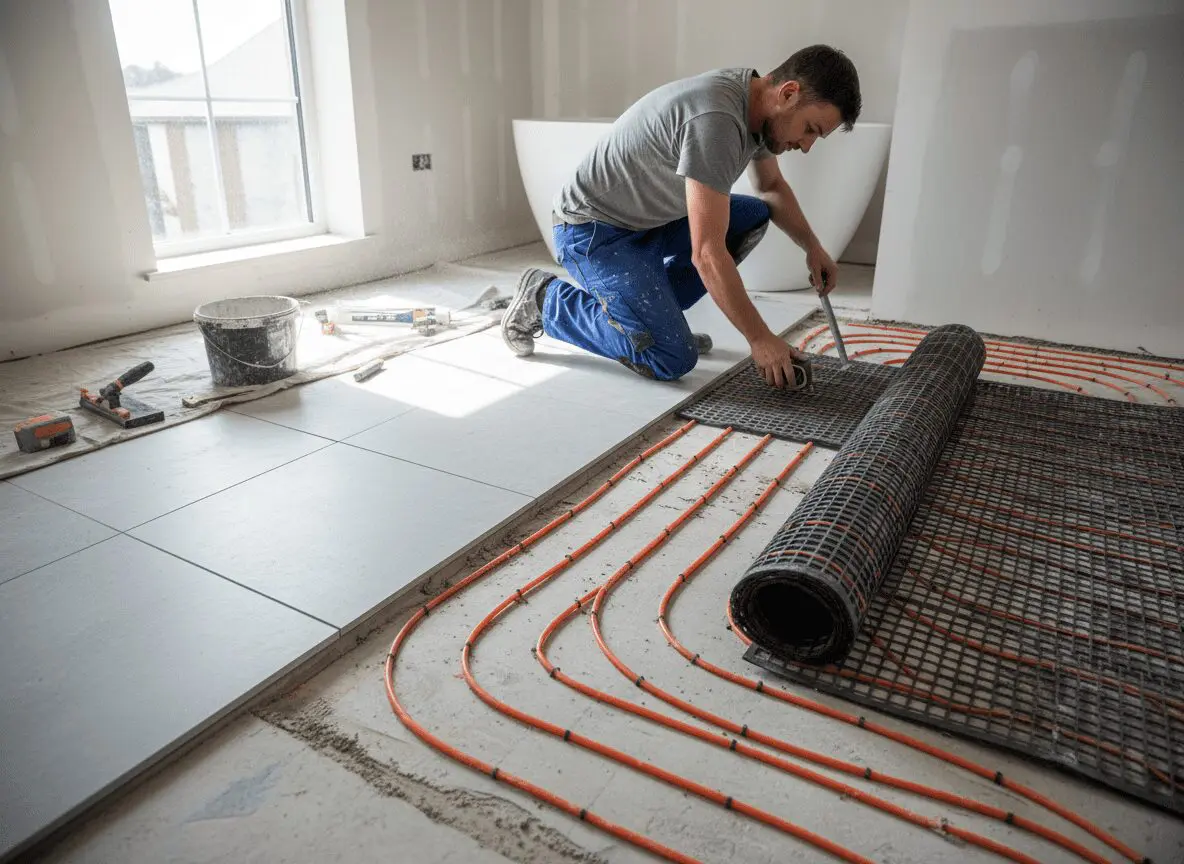
Underfloor heating has become an increasingly popular choice for Sheffield homeowners — and it’s easy to see why. Instead of relying on wall-mounted radiators to heat a room from one side, underfloor heating warms the floor surface evenly across the entire space, creating consistent, comfortable warmth from the ground up.
If you’re looking into underfloor heating for the first time, one of the first decisions you’ll face is choosing between the two main types: wet underfloor heating and dry (electric) underfloor heating. They work in different ways, suit different situations, and have different running costs. This guide explains both systems clearly so you can decide which one makes sense for your home.
How Does Underfloor Heating Work?
All underfloor heating systems work on the same basic principle: heat is distributed evenly across a large surface area at low temperatures, which is more efficient than heating air from a single point source. Rather than a radiator sitting at 70–80°C, underfloor heating systems typically operate at much lower flow temperatures — often 35–50°C for wet systems and controlled by thermostats for electric systems.
The result is a room that heats up gradually and stays comfortable for longer, without hot spots or cold corners.
Wet Underfloor Heating Explained
Wet underfloor heating — sometimes called hydronic underfloor heating — uses warm water pumped through a network of pipes laid beneath the floor. The water is heated by your boiler (or a heat pump, if you have one) and circulated through the pipe loops to warm the floor surface above.
How Wet Underfloor Heating Works
The pipes are typically laid in a continuous loop across the floor area, embedded in screed or within the floor build-up. A manifold controls the flow of water to each zone or room, allowing you to set different temperatures in different areas of your home. The system connects to your existing boiler and is controlled by a thermostat in each room or zone.
Pros of Wet Underfloor Heating
- Lower running costs: Water is a more efficient heat transfer medium than electricity. Once the system is up to temperature, wet underfloor heating is generally cheaper to run than electric systems — especially when paired with a modern condensing boiler or heat pump.
- Ideal for whole-house or large area installation: Wet systems make good economic sense when heating large floor areas. The more space you’re covering, the more the lower running cost adds up over time.
- Compatible with heat pumps: If you’re planning to move towards a heat pump system in future, wet underfloor heating is the ideal partner — heat pumps work at low flow temperatures, which is exactly what underfloor heating requires.
- Long lifespan: The pipes used in wet underfloor heating systems are typically warranted for 25 years or more. Once installed and buried in screed, they’re very low maintenance.
Cons of Wet Underfloor Heating
- Higher installation cost: Wet systems require more materials, skilled installation, and often a screed pour, making the upfront cost higher than electric systems.
- Slower to heat up: Wet systems embedded in screed take longer to reach temperature — sometimes several hours. This means they work best when programmed to run on a schedule rather than being turned on and off on demand.
- More disruptive to install in existing properties: Retrofitting a wet system involves lifting floors, adding depth to the floor build-up, and potentially rerouting pipework — which can be a significant undertaking in a lived-in home.
Wet Underfloor Heating: Best For
New builds, extensions, and full renovation projects where floors are being taken up anyway. Also a good choice for any home where you’re installing underfloor heating throughout multiple rooms at the same time, and where long-term running costs matter.
Dry (Electric) Underfloor Heating Explained
Dry underfloor heating uses electric heating elements — either as a mat or a loose cable — laid beneath the floor surface. There are no pipes and no connection to your boiler. The elements heat up when electricity flows through them, warming the floor above.
How Electric Underfloor Heating Works
Electric underfloor heating comes in two main forms. Heating mats are pre-spaced electric cables attached to a fibreglass mesh, which you roll out and fix to the subfloor before tiling or laying other floor finishes. Loose cables offer more flexibility and can be used in irregular-shaped rooms. Both types are connected to a thermostat and draw power from your home’s electrical supply.
Pros of Electric Underfloor Heating
- Lower installation cost: Electric underfloor heating is significantly cheaper to install than a wet system. For small areas, the cost can be very reasonable — making it accessible even for a single bathroom or kitchen upgrade.
- Faster to heat up: Electric systems respond quickly. Some mats reach operating temperature within 20–30 minutes, making them suitable for on-demand use in bathrooms or kitchens.
- Minimal disruption to install: Because there are no pipes and no screed required, electric mats can often be installed without significantly raising the floor height. This makes them a practical option for retrofitting into existing rooms.
- Easy to zone by room: Each room or area has its own thermostat, so you only heat the spaces you’re using, when you’re using them.
Cons of Electric Underfloor Heating
- Higher running costs: Electricity is more expensive per unit of energy than gas. For small areas used occasionally, this is manageable. For heating a whole house full-time, the running costs of electric underfloor heating can become significant.
- Not ideal for large areas: Electric underfloor heating is most cost-effective in smaller rooms. Using it as the primary heat source for large living spaces or across a whole property tends to push running costs higher than most homeowners expect.
- Shorter lifespan than wet systems: Electric heating elements typically have a shorter lifespan than the pipes used in wet systems, though quality products still carry good warranties.
Electric Underfloor Heating: Best For
Individual rooms — particularly bathrooms, en-suites, kitchens, and conservatories — where you want the comfort of a warm floor without the cost and disruption of a full wet system. Also a sensible choice for retrofitting into existing rooms where lifting floors and pouring screed isn’t practical.
Wet vs Dry: Which Is Cheaper to Run?
Over the long term, wet underfloor heating is generally cheaper to run for large areas. This is because water carries heat more efficiently than electrical resistance, and because modern condensing boilers and heat pumps are highly efficient at heating water to the relatively low temperatures underfloor heating requires.
For a typical three-bedroom home with whole-house wet underfloor heating, running costs can be comparable to or lower than a conventional radiator system — particularly if paired with a modern boiler or heat pump.
Electric underfloor heating running costs depend heavily on how it’s used. A 5m² bathroom mat used for an hour or two each morning will add a modest amount to your electricity bill. Heating a large kitchen-diner all day with electric underfloor heating is a different matter — it can become expensive.
As a rough guide: if you’re covering more than around 20m² or planning to use the heating for extended periods, wet underfloor heating usually wins on running costs over time, even though it costs more upfront to install.
Can Underfloor Heating Work With Any Floor Type?
Most floor coverings are compatible with underfloor heating, but the material affects how well heat transfers upwards. Here’s a quick summary:
- Tiles and stone: Excellent conductors of heat — these work very well with underfloor heating and reach temperature quickly
- Engineered wood: Generally compatible, though you need to check the manufacturer’s guidance on maximum temperature limits
- Laminate: Many laminates are suitable for underfloor heating, but again check the product specifications
- Solid timber: Can be used but requires careful temperature management — solid wood expands and contracts, and some species are not suitable
- Carpet: Can work, but acts as an insulator. Thick underlay and dense carpets significantly reduce heat transfer. Thin, low-tog carpets are preferable if you want underfloor heating to work effectively beneath them
- Vinyl and LVT: Usually compatible — check the product rating for underfloor heating use
If you’re unsure whether your planned floor covering will work with underfloor heating, ask your installer before making any purchasing decisions.
Can You Add Underfloor Heating to an Existing Home?
Yes — both wet and electric systems can be retrofitted into existing homes, though the practicality and cost varies.
Electric systems are the easier retrofit option. Heating mats can be laid directly over existing subfloors in many cases, adding only a small amount of height to the floor. For bathrooms being retiled anyway, this is often a straightforward addition.
Wet systems require more work when retrofitting. Unless floors are already being lifted for other reasons, the disruption of installing pipes and pouring screed means it’s typically only practical in rooms undergoing full renovation. However, low-profile wet systems using thinner pipes and overlays — rather than a full screed pour — have made retrofitting more accessible in recent years.
Which Underfloor Heating System Should You Choose?
To summarise:
- Choose wet underfloor heating if you’re building a new property, doing a significant renovation, or installing underfloor heating across multiple large rooms. The higher upfront cost is offset by lower running costs, a longer lifespan, and better compatibility with heat pumps.
- Choose electric underfloor heating if you want to add a warm floor to one or two rooms — particularly bathrooms or kitchens — without major building work. It’s quick to install, affordable upfront, and well-suited to occasional use in smaller areas.
If you’re still unsure which system suits your home, the best next step is to talk to a qualified heating engineer who can assess your property and give you practical advice based on what you’re trying to achieve.
Underfloor Heating Installation in Sheffield
Heat365 installs and services both wet and electric underfloor heating systems across Sheffield and surrounding areas, including Rotherham, Chesterfield, Barnsley, Doncaster, and Worksop. Whether you’re planning a new build, an extension, or a single room upgrade, we can help you choose the right system and carry out the installation properly.
You can find out more about our underfloor heating installation and repair services on our website. If you’re also replacing or installing a boiler as part of a wider heating project, take a look at our boiler installation Sheffield page too.
Get Advice on Underfloor Heating in Sheffield
Not sure which system is right for your home? Call Heat365 on 07534 793949 for straightforward advice — no jargon, no hard sell. We’ll help you work out what makes sense for your property and budget.