Underfloor heating is brilliant when it works — warm floors, no radiators taking up wall space, even heat across every room.
But like any heating system, it needs regular attention to keep running efficiently and avoid expensive breakdowns.
This guide explains what underfloor heating servicing actually involves, how often you need it, and the warning signs to watch out for.
In this guide
- What does underfloor heating servicing involve?
- How often should you service it?
- Electric vs water systems: different maintenance needs
- Warning signs your system needs attention
- Common underfloor heating faults explained
- What does servicing cost in Sheffield?
- How to prevent costly repairs
- Frequently asked questions
What Does Underfloor Heating Servicing Involve?
Underfloor heating servicing is not a single standard job — what’s checked depends on whether you have an electric or hydronic (water-based) system, how old the installation is, and whether you’ve noticed any issues.
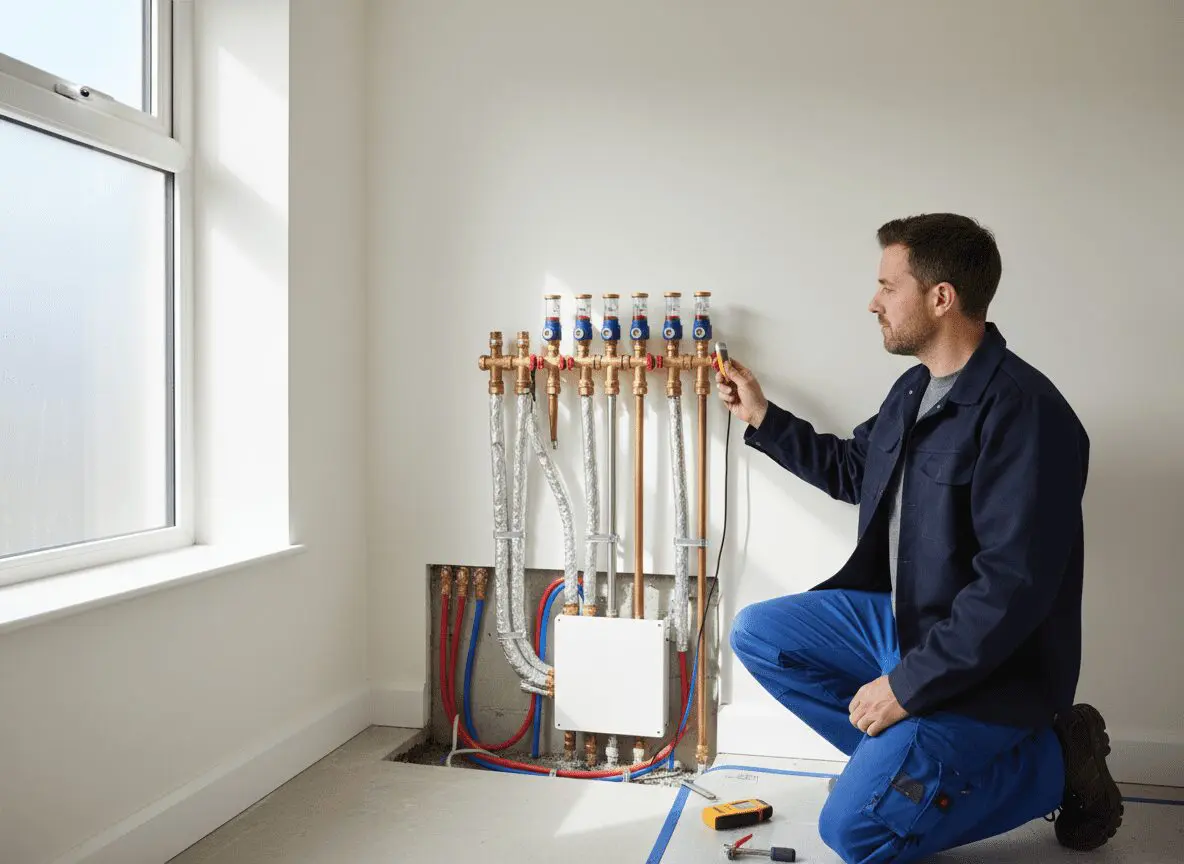
For a water-based (hydronic) underfloor heating system, a full service will typically include:
- Checking system pressure and topping up if needed
- Inspecting the manifold for leaks, corrosion, or flow issues
- Checking and cleaning the pump and actuators
- Testing all zone controls and thermostats
- Checking flow rates across each circuit
- Flushing and inhibiting the system if water quality has deteriorated
- Inspecting the boiler connection (for wet systems fed from a boiler)
For an electric underfloor heating system, servicing focuses on:
- Testing the heating element resistance (to detect early damage)
- Checking the thermostat and programmer are calibrated correctly
- Inspecting the electrical connections at the stat and consumer unit
- Testing floor sensor accuracy (if fitted)
What a service won’t always include
If the pipes or cables are embedded in screed, a service cannot physically inspect them — it checks everything accessible at the manifold, thermostat, and pump level. If there’s a fault in the floor itself, specialist leak detection or electrical testing will be needed as a separate job.
How Often Should You Service Underfloor Heating?
For most homes in Sheffield and surrounding areas, the recommended intervals are:
- Water-based systems: Annual service, ideally in late summer before you need it for the heating season
- Electric systems: Every 2–3 years unless you notice a problem, or annually if the system is older than 10 years
A lot of homeowners skip servicing because the system “seems fine.” The problem is that underfloor heating faults develop slowly — by the time something is noticeably wrong, the damage is often more extensive than it would have been with early intervention.
If you have a wet system connected to a boiler, the boiler service and underfloor heating service are sometimes done together. However, they require different checks, so it’s worth confirming your engineer is covering both rather than just the boiler.
Inherited a property with underfloor heating?
If you’ve moved into a home and don’t have service records, get the system inspected before winter — especially for water-based systems. Old inhibitor, blocked manifold ports, or a failing pump are all things that become obvious during an inspection but cause serious problems if left.
Electric vs Water Underfloor Heating: Different Maintenance Needs
Electric underfloor heating
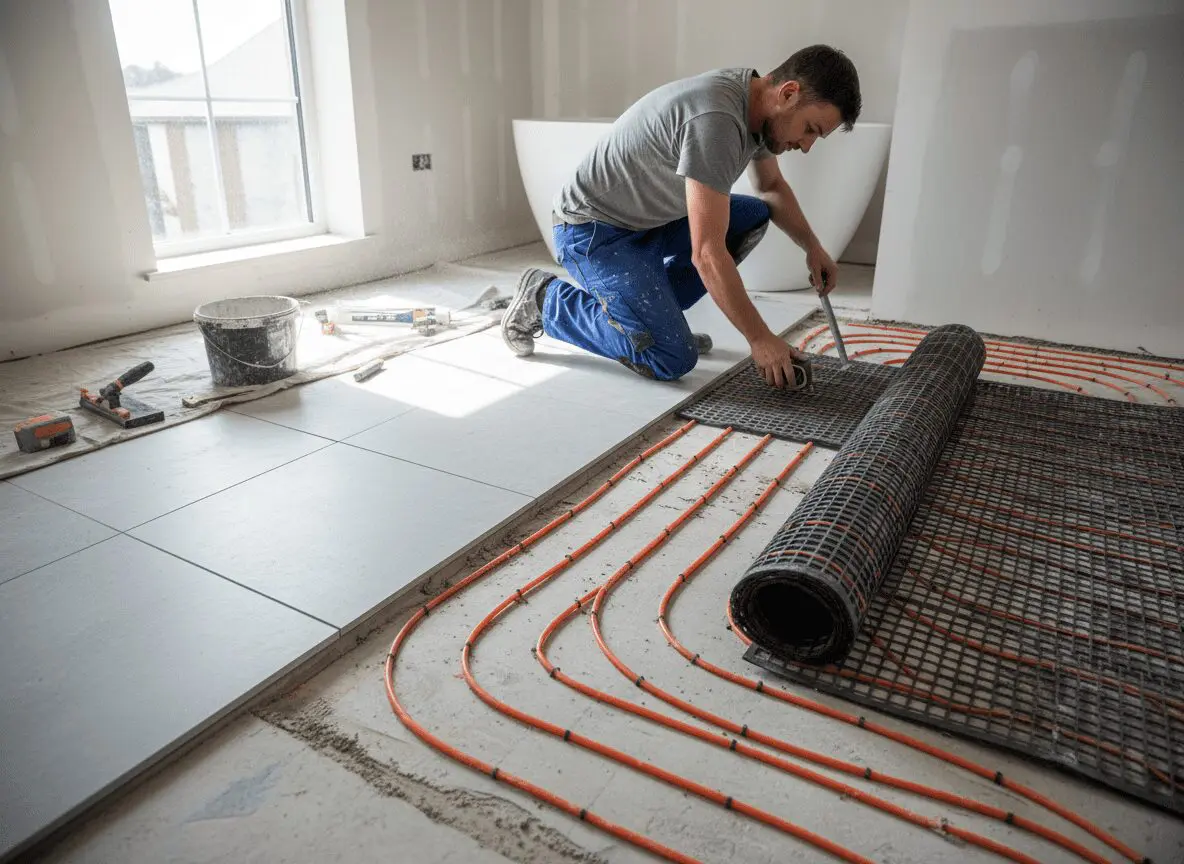
Electric systems use heating cables or matting embedded in the floor. They’re simpler mechanically — no pump, no manifold, no pipes to pressurise.
The main risks are damage to the heating element (often from later drilling or renovation work), thermostat failure, or floor sensor issues. These are generally lower-maintenance systems, but when something does go wrong, it can require lifting floor coverings to access the element.
Checking the element resistance annually with a multimeter is a simple way to spot early-stage damage before it becomes a full failure.
Water-based (hydronic) underfloor heating
Water systems are more complex and have more components that can wear or fail: pumps, actuators, manifold valves, zone controls, and the pipework itself. They’re generally more efficient for larger properties or whole-house heating, but they need more consistent maintenance.
Inhibitor levels in the water are a common thing that gets overlooked. Without inhibitor, the water becomes corrosive and can damage the manifold, pump, and pipework from the inside — all without any external signs until something fails.
Heat365 services both types of system across Sheffield, Rotherham, Chesterfield, Barnsley, and Doncaster. If you’re not sure which type you have, a quick call will help us advise.
Warning Signs Your Underfloor Heating Needs Attention
Don’t wait for a full breakdown before calling an engineer. These are the signs that something isn’t right:
- Cold zones or cold spots — one room or part of a room isn’t warming up, even after an hour
- System taking much longer to heat up — floor used to be warm in 30 minutes and now it takes 2 hours
- Thermostat reading correctly but floor feels cold — suggests a pump, actuator, or flow problem
- Strange noises from the manifold area — gurgling, clicking, or humming that wasn’t there before
- Pressure dropping regularly on a wet system — there may be a slow leak in the floor pipework or at the manifold
- Higher than usual energy bills — the system is working harder than it should to maintain temperature
- Error codes on the thermostat or controller — these need to be diagnosed rather than reset and ignored
Any of these warrant a call to a qualified heating engineer. Catching a fault early almost always means a cheaper and simpler repair.
Common Underfloor Heating Faults Explained
Faulty actuator (water system)
Actuators sit on the manifold and open or close to allow flow into each zone. When they fail, a zone either stays permanently cold (actuator stuck closed) or warm all the time (stuck open). Replacing an actuator is usually a straightforward job when the manifold is accessible.
Pump failure (water system)
The pump circulates water through the system. If it fails completely, the whole system stops working even though the boiler is running fine. If it’s running but struggling, some zones may be warm and others cold depending on resistance in the circuits.
Damaged heating element (electric system)
The heating element under the floor can be damaged by later renovation work — drilling, nailing, or cutting into the screed or subfloor. A partial break causes a cold section. A complete break causes the entire circuit to fail. In some cases, an electrician can repair the element with a specialist splice kit; in others, the flooring needs to come up.
Thermostat or sensor failure
Both electric and water systems rely on thermostats. A failed stat can cause the system to run continuously (high bills), not run at all (cold floor), or behave erratically. Replacing a stat is usually affordable and quick. The floor sensor (which tells the stat when the floor has reached the right temperature) is another common failure point in electric systems.
Dirty or degraded system water
In wet systems, water quality degrades over time. Sludge builds up in the pipework and manifold, reducing flow and efficiency. A system flush with fresh inhibitor restores performance — and can make a significant difference to running costs.
What to do if your underfloor heating stops working completely
- Check the thermostat is set correctly and the programmer hasn’t lost its schedule
- For wet systems: check the pressure gauge on the boiler — if it’s below 1 bar, repressurise
- Check the circuit breaker for the underfloor heating hasn’t tripped
- If none of these fix it, call a heating engineer — don’t keep resetting error codes without diagnosis
What Does Underfloor Heating Servicing Cost in Sheffield?
Costs vary depending on the system type, size, and what’s found during the inspection. As a general guide for Sheffield and South Yorkshire:
- Electric system health check: £60–£120 depending on system size
- Water system service (manifold, pump, zones, thermostat check): £120–£200 for a typical home
- System flush and inhibitor recharge: £150–£300 depending on system size
- Actuator replacement: £80–£150 per zone including parts and labour
- Pump replacement: £150–£300 including parts and labour
These are indicative figures. The best way to get an accurate price is to describe your system and any symptoms to our team — we’ll give you a clear quote before any work begins.
Is servicing worth it?
Compared to the cost of a pump or manifold replacement when a fault has progressed, a service is very good value. It also keeps the system running efficiently — a poorly maintained wet system can use 15–20% more energy than one that’s been properly looked after.
How to Prevent Costly Underfloor Heating Repairs
Most expensive underfloor heating repairs are preventable. Here’s what makes the biggest difference:
- Book an annual service for wet systems — inhibitor levels, pump condition, and manifold checks catch problems before they escalate
- Don’t ignore thermostat errors — error codes are diagnostic information, not something to reset and hope for the best
- Before any renovation work near underfloor heating — tell your contractor the system is there. Cable and pipe routing should be on your installation documents; if you don’t have them, ask us to trace the system first
- Run the system briefly in summer — for wet systems especially, a short circulation run prevents stagnation and keeps the pump moving
- Don’t run the system without inhibitor — if you’ve recently had the system drained and refilled, make sure inhibitor was added before it was brought back into service
Frequently Asked Questions
Can I service my underfloor heating myself?
For electric systems, you can check the thermostat settings and look for error codes yourself. Testing the element resistance requires a multimeter and some electrical knowledge. Anything involving the wiring or consumer unit connection should be done by a qualified electrician. For wet systems, pressure checks are something homeowners can monitor, but manifold, pump, and inhibitor work should be carried out by a qualified heating engineer — especially if the system is connected to a boiler.
My underfloor heating is warm in some rooms but not others — what’s wrong?
This is most commonly a zone control issue — a failed actuator, a blocked circuit, or a thermostat fault in that area. It can also be caused by an imbalanced system where some circuits get more flow than others. A heating engineer can test each zone and identify the issue relatively quickly.
How long does a service take?
A standard service on a water-based system typically takes 1.5–2.5 hours depending on the number of zones and whether any issues are found. An electric system health check is usually 45–90 minutes. If a flush is needed, allow half a day.
Do I need to be in while the work is carried out?
For most servicing work, yes — the engineer will need access to the manifold (usually in a cupboard or utility area) and to each thermostat. They may also need to walk through each zone to check the floor temperature at various points.
My underfloor heating was installed 10 years ago and has never been serviced — is it too late?
It’s never too late to service a system. A long-overdue first service may find more issues than a routine annual one — degraded water, worn pump, tired actuators — but it’s still far better than continuing without one. Many systems that haven’t been maintained still respond very well to a flush and service.
Booking underfloor heating servicing or repairs in Sheffield? Heat365 services and repairs both electric and wet systems across South Yorkshire — see our full underfloor heating service.