What a Proper Boiler Installation Includes: Inside Our Latest Ideal Logic Max Fit
Old boiler out, new Ideal Logic Max in — and then four more jobs that never appear on a “boiler only” quote. On this installation we also fitted a system filter, a scale reducer, a shock arrestor and a compatible thermostat, and the customer walked away with a 10-year warranty from us. This post goes through each of those extras, what it does, and why an Ideal Logic Max installation (or any new boiler) is only as good as the kit fitted around it.
The short answer
A proper boiler installation includes more than the boiler. As well as the appliance itself, expect a cleaned and inhibited heating system, an in-line system filter, scale protection where the water is hard, controls that meet Building Regulations, and a commissioning record. On our latest Ideal Logic Max installation that meant a filter, a scale reducer, a shock arrestor, a compatible thermostat and a 10-year warranty.
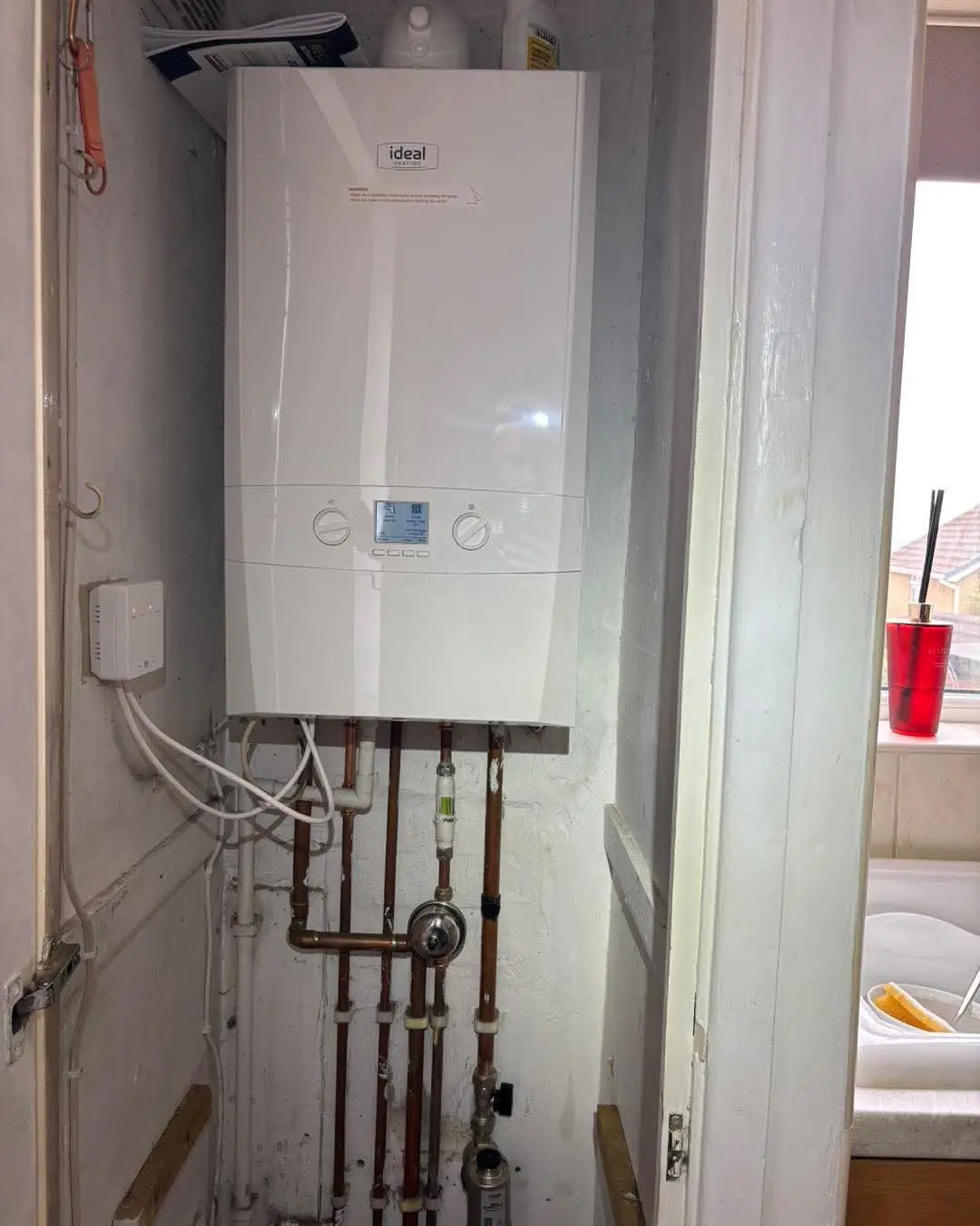
Our Ideal Logic Max installation: what went on the wall
This was a straightforward replacement. The old boiler came off, and a new Ideal Logic Max went up in its place. The boiler is the part everyone sees, and it is the part most quotes are built around.
What made it a proper job was everything else on the pipework underneath it. Here is the full list of what we fitted:
- Ideal Logic Max boiler — replacing the old appliance.
- System filter — to catch debris in the heating water before it reaches the boiler.
- Scale reducer — to slow limescale build-up where the mains water feeds the boiler.
- Shock arrestor — to absorb pressure spikes in the pipework.
- Compatible thermostat — so the controls actually talk to the boiler.
- 10-year warranty — our warranty on this installation.
We put a question to our followers when we shared this job: what is the one thing you refuse to install a new boiler without? The answers vary between engineers, but the principle does not. Hanging a boiler on the wall and hoping for the best is not an installation method.
1. The system filter
Every wet central heating system carries some debris. Older steel radiators and pipework shed fine iron oxide, which settles as the black sludge you see when a radiator is bled or drained. A new boiler has narrower waterways and a heat exchanger that does not tolerate that debris well.
A system filter sits on the return pipe and intercepts the debris as the water circulates, so it is caught and removed at service time rather than collecting inside the boiler. It is not optional in spirit, either. Approved Document L says that before a new heating appliance is installed, the heating circuits should be thoroughly cleaned and flushed, a suitable inhibitor added, and the system prepared and commissioned to BS 7593.
A filter does not replace that cleaning. It keeps a clean system clean. If you want the detail on how the magnetic type works, how often it should be emptied and whether it is worth retrofitting to an older system, we are publishing a dedicated guide to magnetic boiler filters later this autumn.
2. The scale reducer
A scale reducer protects the part of the boiler that heats your tap water. When hard water is heated, the minerals in it come out as limescale and coat the inside of the hot water heat exchanger. Over time that reduces hot water performance and can shorten the life of components.
The same Building Regulations guidance deals with this directly: in hard water areas, suitable measures should be taken to treat the feed water to water heaters and to the hot water circuit of combination boilers to reduce limescale. For the purposes of that guidance, hard water means a total hardness greater than 200ppm of calcium carbonate.
What most quotes get wrong about scale
Water hardness is not the same everywhere we work. It varies across South Yorkshire and Derbyshire, and your water supplier can tell you the figure for your postcode. The mistake is assuming a scale reducer is always pointless, or always essential, without checking. We would rather fit one and explain why than leave the hot water side of a new boiler unprotected.
3. The shock arrestor
If you have ever heard a bang or a shudder in the pipes when a tap or a washing machine valve shuts off quickly, that is water hammer. Water moving through a pipe has momentum. Stop it suddenly and that energy has to go somewhere, which shows up as a pressure spike travelling back along the pipework.
A shock arrestor, sometimes called a water hammer arrestor, is a small device fitted to the pipework that absorbs those spikes. Fitting one alongside a new boiler protects the boiler’s own valves and fittings from repeated knocks, and it usually makes the plumbing noticeably quieter as a side benefit.
It is a small part and an inexpensive one. That is exactly why it is so often left off: the customer never sees it on the quote, so there is no pressure to include it.
4. A compatible thermostat
A new boiler with old or mismatched controls is like a new car with a sticking accelerator. The thermostat decides when the boiler fires and for how long, and that has a bigger effect on running costs than most people expect.
Controls are also a compliance point. Under the Boiler Plus standard in England, timers and room thermostats became an explicit requirement for gas and oil systems. When a gas combination boiler is installed in an existing home, Approved Document L asks for at least one additional energy efficiency measure as well:
- flue gas heat recovery,
- weather compensation,
- load compensation, or
- a smart thermostat with automation and optimisation.
Fitting a thermostat that is designed to work with the boiler is the simplest way to make sure the controls do their job properly. A generic on/off stat from a drawer will switch the heating, but it will not get the best from a modern modulating boiler. If you are weighing up smart controls, our guide to choosing and fitting a smart thermostat covers the options.
5. The 10-year warranty
This installation came with a 10-year warranty from us. We mention it here because a long warranty is only meaningful when the rest of the installation is right. A boiler fitted onto a dirty, untreated system with no filter is not a boiler anyone wants to stand behind for a decade.
Warranty terms differ between installers and manufacturers, so always ask what yours covers, who you call if something goes wrong, and whether anything is needed from you, such as an annual service, to keep it valid. Our annual boiler service is the easiest way to keep that side of things on track.
Why a cheap “boiler only” quote leaves these out
When you compare boiler quotes, the headline price usually tracks the boiler model. The extras are where the difference hides. A low quote can be low because it leaves out:
- cleaning and flushing the existing system before the new boiler goes on,
- the system filter,
- scale protection on the hot water side,
- a shock arrestor,
- controls that match the boiler and meet the regulations, and
- proper commissioning paperwork.
None of those items is expensive on its own. Leaving them all out, though, can make a quote look far more competitive than it really is. It also shifts the cost onto you later, in the form of sludge, scale, noisy pipes or a warranty that does not hold up.
Our breakdown of what goes into the price of a new boiler explains how the numbers are built, and our guide to how long the fitting takes shows where the time on the day actually goes.
What to ask your installer to include
We asked other engineers what they refuse to install a boiler without. Turned around for homeowners, the better question is: what should you ask for in writing before you agree to a quote? This checklist covers the essentials.
- Will the system be cleaned and flushed first? Ask how, and whether an inhibitor goes in afterwards.
- Is a system filter included? Ask where it will be fitted and how it is cleaned.
- What about scale? Ask whether your water is hard enough to need a scale reducer and what they are fitting.
- Are there any pressure or noise issues to deal with? A shock arrestor is cheap to add at the time and awkward to add later.
- Which controls are included? Ask how they meet the Boiler Plus requirements if it is a combi.
- Who gives the warranty, and for how long? Ask what you need to do to keep it valid.
- Will I get the commissioning paperwork? The Benchmark checklist is the usual way this is recorded.
A good installer will answer all of that without hesitation. If a quote goes quiet on most of the list, that tells you something about the installation you are being offered.
Common questions
What should be included in a new boiler installation?
Beyond the boiler itself, a proper installation should include cleaning and flushing the existing system, adding inhibitor, an in-line system filter, scale protection where the water is hard, controls that meet Building Regulations, and commissioning to BS 7593 with the paperwork to show it.
Do I need a scale reducer with a new combi boiler?
If you live in a hard water area, the Building Regulations guidance says suitable measures should be taken to treat the water feeding the hot water side of a combi boiler. Hard water is defined in that guidance as above 200ppm of calcium carbonate. Your water supplier can confirm the hardness for your postcode.
What does a water hammer arrestor do?
It absorbs the pressure spike created when fast-closing valves stop the flow of water suddenly. That reduces banging in the pipes and protects valves and fittings, including those on a new boiler, from repeated shocks.
Is a system filter required on a new boiler?
Approved Document L asks for the system to be cleaned, inhibited and commissioned to BS 7593 when a new boiler goes in. An in-line filter is the usual way installers keep a cleaned system clean afterwards, which is why one was on the list for this Ideal Logic Max installation.