If your radiators are slow to heat up, warm at the top but cold at the bottom, or your boiler is making knocking or gurgling noises, the problem might not be your boiler at all. It could be a build-up of sludge and debris inside your central heating system.
A power flush is one of the most effective ways to clear this build-up and restore your heating to full efficiency. In this guide, we’ll explain what a power flush actually does, how to tell if you need one, what happens on the day, and what it’s likely to cost in the Sheffield area.
What Is a Central Heating Power Flush?
Over time, the water that circulates through your central heating system picks up rust, limescale, and other debris from pipes, radiators, and fittings. This settles as a dark, sludgy deposit known as magnetite — and it causes real problems for heating performance and boiler longevity.
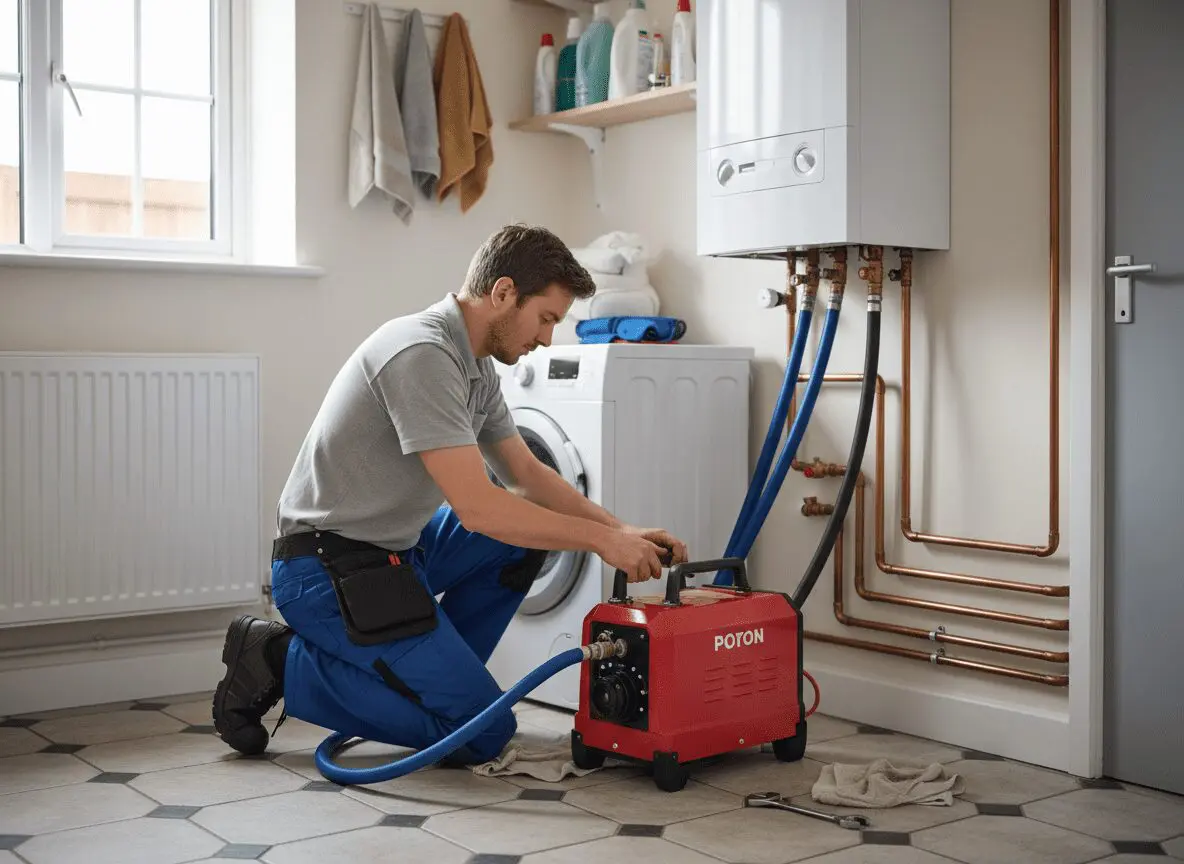
A power flush uses a specialised machine to push high-flow water through your entire heating system, dislodging and removing this sludge. A cleaning chemical is added to break down deposits, and the contaminated water is flushed out and replaced with clean water treated with inhibitor — a chemical that helps prevent future corrosion and build-up.
The result is a cleaner, more efficient system that heats up faster and more evenly, puts less strain on your boiler, and is less likely to break down.
Signs You Might Need a Power Flush
These are the most common signs that your central heating system has a sludge problem:
- Radiators cold at the bottom but warm at the top — sludge settles at the lowest point of each radiator
- Some radiators not heating up at all — despite the boiler running
- Boiler making banging, kettling, or gurgling noises — often caused by sludge in the heat exchanger
- Heating takes a long time to warm up — the system is working harder than it should
- Boiler cutting out repeatedly — sludge can cause the boiler to overheat and lock out
- Dark or discoloured water when you bleed radiators — a clear sign of contamination
- Higher energy bills — a sludged system uses more fuel to deliver the same heat
Not every issue means you need a power flush — some problems have simpler causes — but if you’re seeing several of these signs together, it’s worth having an engineer assess your system.
When Is a Power Flush Recommended?
Before a New Boiler Installation
If you’re replacing your boiler and your existing system is older or hasn’t been maintained regularly, most engineers — and boiler manufacturers — will recommend a power flush before the new unit goes in. Fitting a new boiler to a contaminated system can significantly shorten its lifespan and may affect your warranty.
When the System Hasn’t Been Flushed Before
If your central heating system has never been flushed and is more than 10-15 years old, there’s a reasonable chance sludge has built up inside it. This is especially likely if inhibitor hasn’t been added and topped up over the years.
When a System Inhibitor Hasn’t Been Used
Inhibitor is a chemical added to the system water to prevent corrosion and scale. Without it, rust and debris accumulate far more quickly. If your system has been running without inhibitor for several years, a flush may be needed to clear what’s already built up before the inhibitor can do its job.
After Multiple Boiler Repairs
If your boiler has needed repeated repairs for similar issues — particularly if it keeps overheating or losing pressure — the root cause could be contamination in the system rather than a fault with the boiler itself.
What Happens During a Power Flush?
Here’s a straightforward walkthrough of what to expect when an engineer carries out a power flush at your property.
Assessment
Before starting, the engineer will check your system — testing radiators for cold spots, inspecting the boiler, and assessing overall condition. This helps confirm whether a power flush is appropriate and identifies any components that might need attention.
Connecting the Machine
The power flush machine is connected into the central heating system — usually via the pump head or a convenient connection point. The engineer will isolate the boiler at this stage to protect it from the flushing process.
Chemical Treatment
A descaling or sludge-breaking chemical is introduced into the system. The machine then circulates this at high flow through your pipework and radiators, loosening and breaking down deposits that have built up over time.
Flushing Each Radiator
The engineer will work through the system radiator by radiator, directing flow through each one in turn and using the machine’s reversing function to dislodge stubborn sludge. The water coming out of the system is checked with a testing device to monitor how much contamination is present.
Flushing Out the System
Once the chemical has done its work, the contaminated water is flushed out of the system entirely. This can take some time — the engineer will continue until the water coming out runs clean and testing shows acceptable contamination levels.
Adding Inhibitor
Once the system is clean, fresh inhibitor is added to the clean water before it circulates. This protects your system from future corrosion and sludge build-up. A magnetic filter — if one isn’t already fitted — is recommended at this stage to catch any remaining particles.
System Check and Commissioning
The engineer will reconnect the boiler, restart the system, and check that everything is working correctly. Radiators are tested for even heat distribution, and the boiler is checked for proper operation before the engineer signs off the job.
How Long Does a Power Flush Take?
For a typical three or four-bedroom house with eight to twelve radiators, a power flush usually takes between four and eight hours. Larger systems or those with severe sludge build-up may take longer. It’s a full-day job in most cases, so plan accordingly.
What Does a Power Flush Cost in Sheffield?
Power flush costs in the Sheffield area typically range from £300 to £600 for an average-sized home, depending on the number of radiators and the condition of the system.
| System Size | Typical Cost Range |
|---|---|
| Small (up to 8 radiators) | £300 – £400 |
| Medium (8–12 radiators) | £400 – £500 |
| Large (12+ radiators) | £500 – £600+ |
These figures are indicative. The actual cost depends on your system’s size, condition, and any additional work needed — such as fitting a magnetic filter or replacing a faulty radiator valve. A reputable engineer will give you a clear quote after assessing your system, not a fixed price over the phone.
Is a Power Flush Always the Answer?
Not necessarily. If your system is heavily corroded or pipework is in poor condition, a power flush may not be the right solution — in some cases, it can dislodge enough material to cause leaks in weakened pipes. A good engineer will assess your system honestly and recommend the most appropriate course of action, which might be a flush, or might be repair or replacement of specific components first.
It’s also worth noting that a power flush is not a permanent fix if the underlying cause of contamination isn’t addressed. Fitting a magnetic filter, maintaining inhibitor levels, and having your system serviced regularly will help prevent the problem from returning.
How to Prevent Sludge Build-Up in Future
Once your system has been flushed and cleaned, a few simple steps will help keep it in good condition:
- Fit a magnetic filter — catches iron particles and sludge before they circulate through the system
- Top up inhibitor annually — ask your engineer to check and top up inhibitor levels at each boiler service
- Get your boiler serviced every year — a regular service catches early signs of system contamination
- Bleed radiators periodically — and check the colour of the water when you do
Heat365: Power Flushing in Sheffield and South Yorkshire
At Heat365, we carry out central heating power flushes across Sheffield, Rotherham, Chesterfield, Barnsley, Doncaster, and Worksop. Our engineers will assess your system honestly, advise on whether a flush is the right solution, and carry out the work cleanly and thoroughly.
We’ll also advise on fitting a magnetic filter if one isn’t already in place, and check your inhibitor levels are correct before we leave.
Call us on 07534 793949 to arrange a system assessment, or visit heat365.co.uk/boiler-servicing-sheffield for more on our heating and maintenance services.
If your heating hasn’t been performing as well as it should, a power flush could make a significant difference. Get in touch and we’ll take a look.