Underfloor heating is one of the most comfortable and efficient ways to heat a home — but when it stops working properly, it can be hard to know where to start.
Whether you have cold patches underfoot, a system that won’t switch on, or zones that refuse to heat up, most underfloor heating faults have a clear cause.
This guide walks you through the most common problems, what causes them, and what to do next — including when it’s time to call a professional for a proper underfloor heating repair.
No Heat at All: Where to Start
If your underfloor heating has stopped producing any heat at all, it’s easy to assume the worst — but in many cases the fix is straightforward.
Before anything else, run through these basic checks:
- Check the thermostat settings. It sounds obvious, but make sure the thermostat is set to a temperature above the current room temperature and that the heating is actually scheduled to run. Many systems switch to a summer schedule automatically.
- Check the fuse or circuit breaker. Underfloor heating runs off its own circuit in many installations. If a fuse has blown or a breaker has tripped, the system will appear completely dead.
- Check the timer or programmer. If your system uses a separate programmer or smart control, check it hasn’t lost its settings after a power cut.
- Check for an isolation switch. Some systems have a dedicated isolation switch, often in the airing cupboard or near the manifold for water-based systems. If this is off, nothing will work.
If all of these check out and there’s still no heat, the fault is likely deeper in the system — either a component failure, a wiring issue, or a problem with the heating element or pipework underneath the floor.
Worth knowing
Underfloor heating takes longer to respond than radiators — typically 30 minutes to an hour to reach full temperature. If you’ve just turned the system on or adjusted settings, give it time before assuming there’s a fault.
Cold Patches in the Floor
Cold patches are one of the most common complaints with underfloor heating, and they can have several causes depending on whether you have an electric or water-based system.
Cold patches in electric underfloor heating
In an electric system, cold patches usually mean that part of the heating cable or mat has failed. This can happen due to:
- Physical damage to the cable — often caused during the original installation or during later flooring work
- A break in the cable caused by wear over time or by a sharp object penetrating the floor
- A fault in one section of the mat that causes that zone to stop producing heat
A qualified engineer can use a thermal imaging camera or resistance testing to identify the exact location of the fault without the need to lift the entire floor.
Cold patches in water-based underfloor heating
In a hydronic system, cold patches in one area of the floor are often caused by:
- Blockages in the pipework — sludge and debris can accumulate in the pipes over time, reducing or stopping flow in individual loops
- Air locks — air trapped in the system prevents water circulating properly through that section
- Faulty actuators — the small motorised valves on the manifold that control flow to each zone can fail, leaving a loop shut off
- Unbalanced flow rates — if the system was not balanced correctly at installation, some loops receive more flow than others
In many cases, cold patches in a water-based system can be resolved by flushing the affected loop, bleeding the system, or replacing the actuator — all of which are straightforward for an experienced engineer.
Thermostat and Control Problems
The thermostat is often the first place to look when underfloor heating behaves unexpectedly. A faulty or poorly configured thermostat can cause the system to stay off when it should be on, run constantly without reaching temperature, or fail to respond to adjustments.
Thermostat not responding
If the thermostat screen is blank or unresponsive, start with the basics: check the batteries if it’s a wireless model, check the fuse at the receiver unit, and check whether a nearby circuit breaker has tripped.
If the thermostat is wired, a break in the wiring between the stat and the receiver can also cause a loss of response. This is a job for an engineer rather than a DIY fix.
Thermostat showing correct temperature but no heat
This usually suggests the problem is not the thermostat itself but something downstream — the actuator, the pump, or the heating element. The thermostat is reading correctly and sending a signal, but the signal is not being acted on.
System running constantly
If the underfloor heating keeps running even after it reaches the set temperature, the thermostat sensor may be faulty or poorly positioned. Thermostats placed in direct sunlight, near a cold draught, or close to another heat source will give inaccurate readings and behave erratically.
Quick check
Most modern underfloor heating thermostats have a floor sensor probe as well as an air sensor. If the probe has been damaged or disconnected, the system can lose control of the floor temperature and overheat or fail to heat at all.
Common Electric Underfloor Heating Faults
Electric underfloor heating is relatively simple in design — a cable or mat runs under the floor and produces heat when electricity passes through it. When it stops working, the fault is usually one of the following.
Tripped RCD or RCBO
Electric underfloor heating is protected by an RCD (residual current device) or RCBO in the consumer unit. If there is a wiring fault or the system develops an earth leakage problem, the RCD will trip to protect the circuit.
If you reset the RCD and it trips again immediately, do not keep resetting it. This suggests there is an active fault in the system that needs proper diagnosis before it can safely be used again.
High or low resistance readings
An engineer can test the resistance of the heating cable using a multimeter. If the reading is significantly outside the specification shown on the system label, this indicates a fault in the cable — either a break (high resistance) or a short circuit (low resistance). Both mean the cable needs repair or replacement.
Damaged cable under the floor
Physical damage to electric underfloor heating cable is more common than people realise. Subsequent trades working on the property — plumbers, joiners, tilers — can inadvertently drill, screw, or nail into the cable during later work. Identifying the exact location of the break is possible using specialist equipment, but the repair does usually require lifting part of the floor covering.
Common Water-Based Underfloor Heating Faults
Hydronic underfloor heating systems are more complex than electric ones, but the faults that develop tend to follow predictable patterns.
Low system pressure
Like a standard central heating system, water-based underfloor heating relies on correct pressure to circulate water properly. If pressure drops below the recommended level — usually shown on the manifold or control unit — the system will struggle to heat effectively or may fail to run at all.
A slow pressure drop over several weeks usually suggests a small leak somewhere in the system. A sudden drop can indicate a more significant problem. Either way, the system needs to be inspected and the source of the pressure loss identified before simply topping it up repeatedly.
Pump failure
The pump circulates hot water through the underfloor heating loops. If the pump fails or seizes, no water will flow and the floor will not heat up — even if the boiler is working correctly. Pump failure is often accompanied by unusual noises (humming, clicking, or silence where you’d expect to hear the pump running) or the pump running but producing no flow.
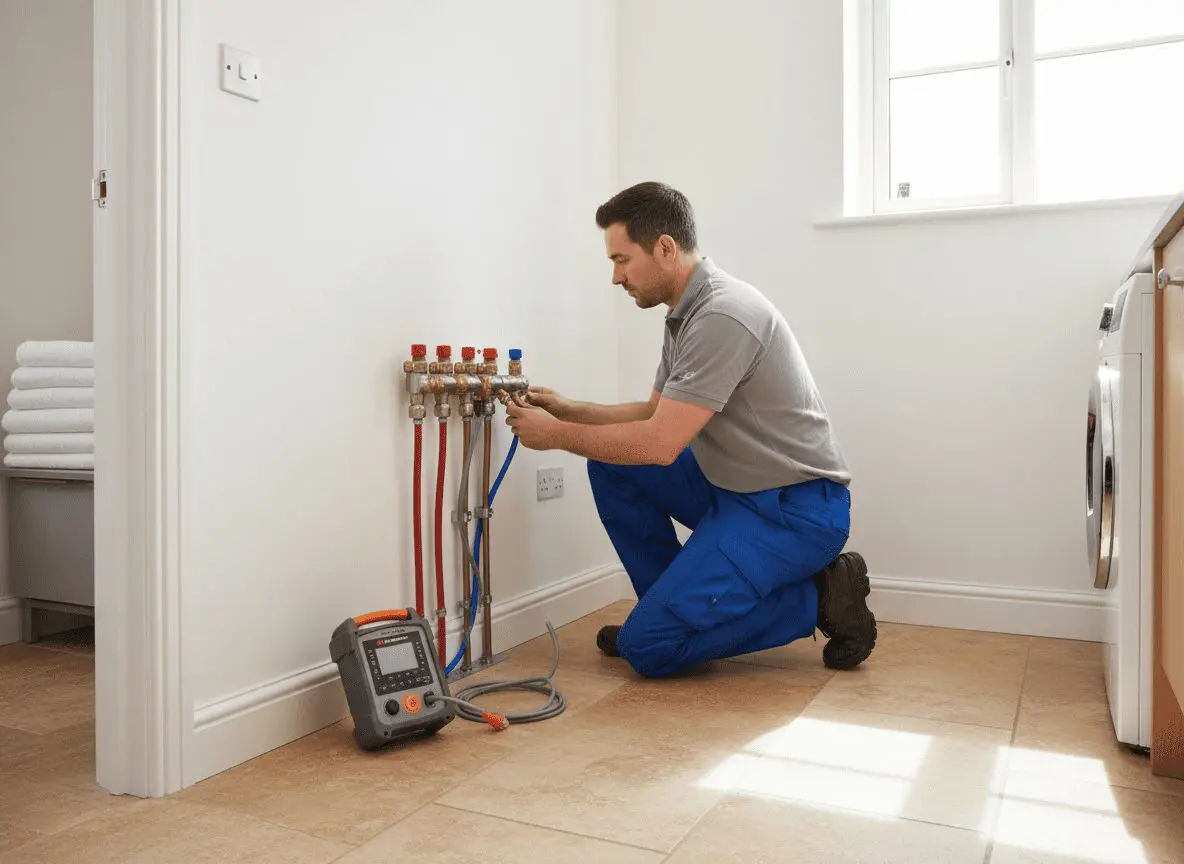
Manifold and actuator faults
The manifold is the distribution point for all the heating loops in a hydronic system. Each loop is controlled by an actuator — a motorised valve that opens and closes to regulate flow. Over time, actuators can stick in the closed position, preventing flow to that zone, or fail in the open position, causing that zone to heat continuously regardless of thermostat settings.
Individual actuators are relatively inexpensive to replace and do not usually require the floor to be disturbed.
Sludge and contamination
In older systems, or systems that have never been flushed, the water can become contaminated with iron oxide (black sludge) and other debris. This sludge settles in the lower points of the system — often in the underfloor heating loops themselves — and causes blockages, reduced flow, and cold patches.
A power flush can remove the majority of this contamination. Adding a magnetic filter and inhibitor after flushing helps prevent the problem from returning.
System Taking Too Long to Heat Up
Underfloor heating is slower to respond than radiators under normal circumstances — that’s simply how it works. A cold floor can take 45 minutes to an hour to reach comfortable temperature in winter. If warm-up times are increasing or the floor never quite feels warm enough, there are a few likely causes.
- Increased floor resistance — new flooring laid on top of the existing surface (a second layer of tiles, for example) adds thermal mass and slows heat transfer. This is not a fault, but it may require thermostat reprogramming.
- Reduced flow rate — partial blockages or actuator issues can restrict flow without stopping it entirely, leading to slower heat-up times and lower maximum temperatures.
- Boiler flow temperature set too low — for water-based systems, if the boiler is sending water at too low a temperature, the underfloor heating will struggle to keep up in colder weather. Flow temperature should be set according to the system design specification.
- Degraded insulation beneath the floor — over time or after water damage, the insulation layer under the heating element can deteriorate. Without proper insulation, heat is lost downwards rather than rising through the floor.
When to Call a Professional for an Underfloor Heating Repair
Some underfloor heating issues are straightforward to resolve at home — resetting the thermostat, topping up system pressure, or checking a tripped breaker. But most faults beyond these basics need a professional diagnosis.
You should contact a heating engineer if:
- The system shows no heat at all and the basic checks have not resolved it
- Cold patches have developed that were not there before
- The system pressure keeps dropping and you cannot identify the cause
- The RCD keeps tripping when the underfloor heating is switched on
- The thermostat is behaving erratically or not responding
- You can hear the pump running but the floor is not heating
- There are signs of a leak — damp patches, unexplained moisture — near the manifold or on the floor surface
Attempting to open manifolds, test cables, or interfere with wiring without the right tools and knowledge can make the fault worse and potentially create a safety risk. An experienced engineer will be able to diagnose the problem accurately and advise on the most cost-effective repair.
Heat365 — Underfloor Heating Repairs in Sheffield
Heat365 carries out underfloor heating repairs and fault diagnosis across Sheffield and the surrounding areas, including Rotherham, Chesterfield, Barnsley, Doncaster and Worksop. Our engineers are Gas Safe registered and experienced with both electric and water-based systems.
If your underfloor heating has stopped working or isn’t performing as it should, get in touch and we’ll take a look.
Frequently Asked Questions
Why has my underfloor heating stopped working suddenly?
Sudden failure is usually caused by a tripped circuit breaker, a blown fuse, a thermostat that’s lost its settings, or — in water-based systems — a pump or actuator fault. Start with the basic checks above before calling an engineer.
Can underfloor heating cables be repaired without lifting the floor?
In some cases, yes. Specialist fault-finding equipment can identify the exact location of a cable break, and some repairs can be made by accessing just a small section of flooring rather than lifting everything. An engineer will be able to advise after testing the system.
How much does an underfloor heating repair cost?
Repair costs vary depending on the type of system and the nature of the fault. Replacing a thermostat or actuator is relatively inexpensive. Tracing and repairing a cable break under tiles is more involved. The best way to get an accurate figure is to have the system diagnosed first.
Is it safe to use underfloor heating with cold patches?
Cold patches in an electric system should be investigated before continued use, particularly if the circuit is tripping or the system is behaving unusually. Cold patches in a water-based system are not normally a safety issue but indicate a problem that will affect efficiency and may worsen over time.
My underfloor heating works but the floor never feels warm. What’s wrong?
This is often a sign that the flow temperature (in a water system) is too low, insulation beneath the floor has degraded, or there’s a partial blockage reducing flow. It could also be that new flooring has been added on top, which changes how quickly heat comes through. An engineer can diagnose the specific cause.