Reviewed and signed off by Heat365| Published 1 October 2026 | Last updated 1 October 2026
There is a sentence in UK law that quietly governs every gas boiler in every workplace in the country, and almost nobody who runs a business has read it. Regulation 35 of the Gas Safety (Installation and Use) Regulations 1998 places a duty on every employer or self-employed person to ensure that any gas appliance, installation pipework or flue at a place of work under their control is maintained in a safe condition so as to prevent risk of injury to any person. Note what it does not say: it never mentions twelve months, and it never mentions a certificate.
In this guide
- The legal duty, in plain English
- Who counts as “commercial” — and who does not
- Why a domestic engineer cannot touch it
- What a commercial boiler service should include
- Certificates and records: what you should be handed
- How often, and why twelve months is a floor
- What actually drives the cost
- Frequently asked questions
The Legal Duty, in Plain English
Regulation 35 is short and it is absolute. If you are an employer or self-employed, and there is a gas appliance, pipework or a flue at a place of work you control, you must keep it in a safe condition so that nobody gets hurt.
What makes this different from the domestic world is the absence of a prescribed interval. A landlord letting a house has a separate, explicit twelve-month duty and a certificate to prove it. A business running a boiler in its own premises has a continuous duty and no statutory form.
That sounds like less work. It is actually more exposure. With no fixed deadline, there is no moment at which you are automatically compliant — you are simply expected to be able to demonstrate, at any point, that the appliance has been maintained. In practice that demonstration is a file of dated service records from a suitably qualified engineer.
Who Counts as “Commercial” — and Who Does Not
This is where most of the confusion on Sheffield industrial estates and high streets comes from. “Commercial” in gas terms is not about the size of the building or the size of the boiler. It is about two things: the setting, and the appliance rating.
| Situation | What applies |
|---|---|
| House or flat you let to tenants | Domestic duty — a twelve-month gas safety check and a record for the tenant |
| Shop, office, salon, workshop, warehouse you operate from | Regulation 35 duty as employer — maintain in a safe condition, keep records |
| Pub, café, restaurant or takeaway kitchen | Regulation 35 plus catering-specific requirements covering appliances, ventilation and interlocks |
| Care home, school, place of worship, community hall | Regulation 35, usually with a stricter internal compliance regime imposed by insurers or a regulator |
| Flat above your own shop, occupied by you | Domestic in nature, but the commercial part of the premises still carries the employer duty |
Plenty of small businesses fall into more than one row at once. A landlord who also runs a business from part of the same building has both duties running in parallel, on different appliances. If you are letting property as well, our guide to landlord gas safety certificates in Sheffield covers that side in detail.

Why a Domestic Engineer Cannot Touch It
Gas Safe registration is not one qualification. It is a register of engineers, each carrying specific appliance categories they are assessed and re-assessed on. A domestic-only engineer is not qualified to work on a commercial appliance, and the register will say so.
The Health and Safety Executive is unambiguous about the consequences. HSE states that in domestic properties and workplaces such as shops, restaurants, schools and hospitals, work on gas fittings must be carried out by a Gas Safe registered engineer who is qualified to do the work — and that it is illegal for anyone else to do it.
The practical check takes thirty seconds. Ask to see the engineer’s Gas Safe ID card and look at the reverse, where the categories they hold are listed. If your appliance type is not on the card, they cannot lawfully work on it, however experienced they are. An unqualified service is worse than no service at all, because it produces paperwork that will not survive scrutiny after an incident.
What a Commercial Boiler Service Should Include
A proper commercial service is a longer job than its domestic equivalent, because there is more to check and more that can go wrong. Expect the engineer to work through:
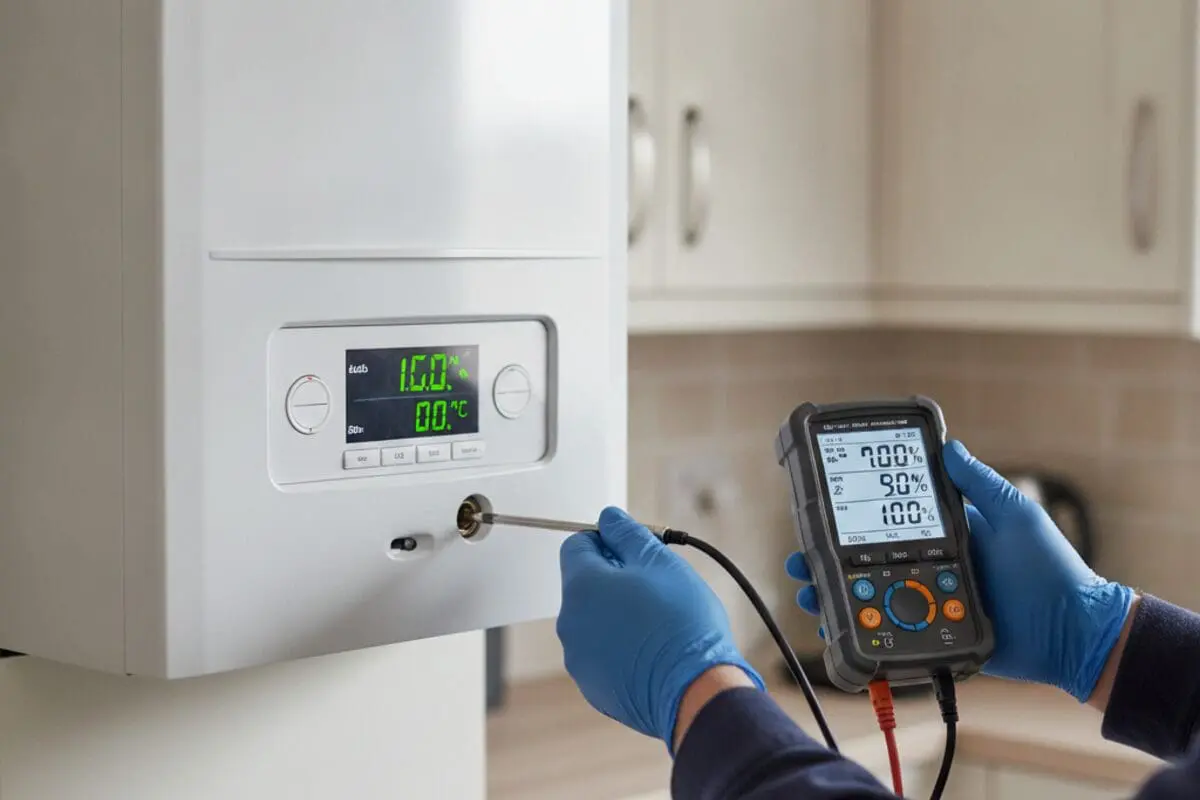
- Combustion analysis — a flue gas analyser reading taken at the appliance and compared against the manufacturer’s stated figures, not a general rule of thumb.
- Gas rate and operating pressure — confirming the appliance is burning what it should be, at the working pressure it was commissioned to.
- Tightness testing of the installation pipework serving the appliance.
- Flue and ventilation — flue integrity, termination position, and whether the room has the air supply the appliance needs. Ventilation blocked by later building work is one of the most common findings.
- Safety devices — flame supervision, overheat and pressure protection, and, in catering settings, gas interlocks tied to the extraction system.
- Controls and system health — pumps, valves, pressurisation, expansion vessel charge, and evidence of circulation problems building up.
- Emergency control valve — accessible, labelled, and known to staff.
Anything found to be immediately dangerous or at risk should be dealt with there and then under the industry unsafe situations procedure, with the appliance turned off and labelled. That is not the engineer being awkward. It is the step that protects you if something happens afterwards.
Certificates and Records: What You Should Be Handed
There is no single statutory certificate for a commercial boiler in the way there is for a let property. What you should receive is a gas safety record or service report that stands up on its own, listing:
- the address and the specific location of each appliance within the premises
- make, model and appliance type for each item checked
- the engineer’s name and Gas Safe registration number
- the date of the inspection
- the readings taken, not just a tick
- any defect found, and the action taken or required
Catering premises are usually issued a commercial catering gas safety record — often referred to by its form number, CP42 — covering cookers, ovens, grills, ventilation and interlocks together. Keep these. Insurers, environmental health officers and any post-incident investigation will all ask for the history, not the most recent sheet.
Store them digitally as well as on paper. A folder in the plant room is no use when the plant room is the part of the building that is on fire.
Heat365 handles commercial boiler and heating work for Sheffield businesses — servicing, repairs and planned maintenance, with records written to survive an audit.
How Often, and Why Twelve Months Is a Floor
Twelve months is the interval almost every business settles on, and for good reason: it matches most manufacturers’ maintenance instructions, it satisfies most insurers, and it produces a clean annual paper trail.
But regulation 35 asks for a safe condition, not an anniversary. Where the appliance runs hard, the sensible interval is shorter. Six-monthly is common for commercial catering kitchens, where grease, heat and constant use age appliances far faster than a wall-hung boiler in an office. The same applies to any premises where an outage would be genuinely serious — a care home in February, for instance.
Two other triggers are worth writing into your maintenance plan. Service after any building work that changes ventilation, adds partitions or alters the route of a flue. And service before the heating season rather than during it, because the failure you find in September is a repair, and the one you find in December is an emergency call-out plus a day of lost trading.
Commercial kitchens have a second failure mode worth understanding, and it is rarely the boiler itself — we have written separately about the plumbing faults that shut Sheffield kitchens down.
What Actually Drives the Cost
Businesses ask for a price and are frustrated to be asked five questions back. Those questions exist because a commercial service is not one job at one price. The real variables are:
- Appliance count. One wall-hung boiler in a cupboard is a different visit from a cascade of three plus a water heater.
- Appliance type and output. Higher-rated and modular plant takes longer to test properly and needs different qualifications.
- Access. Roof-mounted plant, locked risers and shared plant rooms all add time before any work starts.
- Catering interlocks. Testing a ventilation interlock system correctly is a job in itself.
- Timing. Out-of-hours work so you do not lose trading hours costs more per visit and usually saves more than it costs.
- Whether it is planned or reactive. A maintenance contract with fixed visits is almost always cheaper per year than calling someone when it stops.
For comparison, if what you actually have is a domestic-type boiler in a small premises, the scope and price look much closer to a standard boiler service in Sheffield. Get the appliance identified before you compare quotes, because a low quote often just means someone has priced the wrong job.
Frequently Asked Questions
How often should a commercial boiler be serviced?
Annually as a minimum for most premises, and every six months where the appliance runs hard — commercial catering being the obvious case. The legal test is whether the appliance is maintained in a safe condition, so follow the manufacturer’s instructions and increase the frequency where use is heavy.
Is a commercial gas safety certificate a legal requirement?
There is no single statutory certificate for commercial premises in the way there is for let residential property. What is required is that the appliance is maintained safely — and in practice you evidence that with dated service records from a qualified engineer. No records, no defence.
What is a CP42 certificate?
CP42 is the form number commonly used for a commercial catering gas safety record. It covers catering appliances along with ventilation and interlock testing, and is what most environmental health officers and insurers expect to see from a kitchen.
How long should I keep gas safety records for my business?
Keep the full history, not just the current year. Two years is a frequently quoted minimum for catering records, but there is no downside to keeping everything — an investigation will want to see the pattern of maintenance over time, not a single sheet.
Can my usual domestic Gas Safe engineer service our commercial boiler?
Only if they hold the relevant commercial appliance categories on their Gas Safe registration. Check the back of the ID card. HSE is clear that gas work in workplaces must be done by an engineer qualified for that work, and being registered for domestic appliances is not the same thing.
What happens if we cannot produce any records?
Nothing, until something goes wrong — and then the absence of records is the first thing anyone looks for. Book a service, get the appliance assessed and start the file from today. A short history is far better than none.
The Short Version
Commercial gas compliance is less about hitting a date than about being able to prove a pattern. Use a Gas Safe engineer whose card actually carries your appliance category, service annually as a baseline and more often where the plant works hard, and keep every record rather than the latest one.
Heat365 works with businesses across Sheffield, Rotherham, Chesterfield, Barnsley, Doncaster and Worksop, from single-boiler offices to catering kitchens and multi-appliance sites. If your last service record is more than a year old, or you cannot find one at all, that is the job to book this month rather than next winter.