A CCTV drain survey is the quickest way to find out exactly what is happening inside your drains without digging anything up.
Whether you have a recurring blockage, slow drainage, or you are buying a property in Sheffield, this guide covers everything you need to know.
What is a CCTV drain survey?
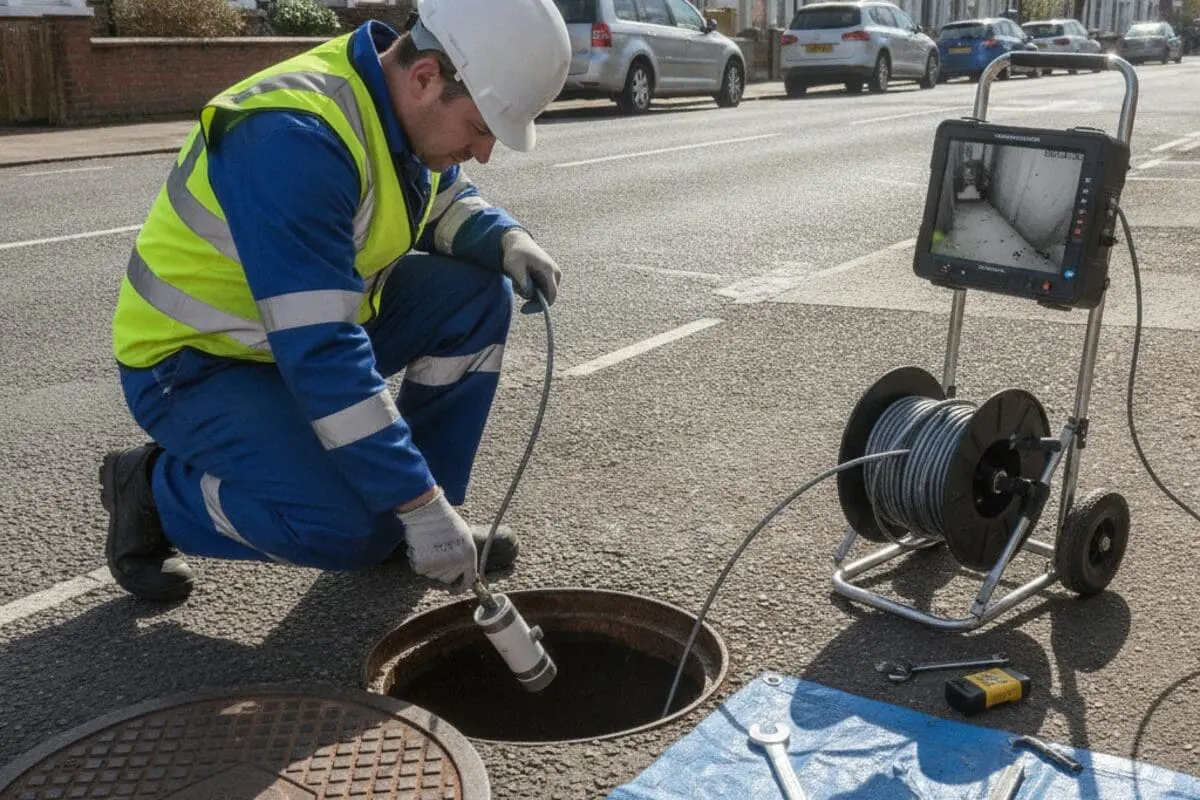
A CCTV drain survey uses a small waterproof camera mounted on a flexible rod or crawler to inspect the inside of your drains and pipes.
The camera feeds live footage to a screen above ground, so the engineer can see exactly what is happening without any excavation.
Surveys cover everything from domestic waste pipes under your kitchen and bathroom to the larger underground drainage runs that connect to the sewer.
Footage is usually recorded so you get a full report with the findings.
No digging required
One of the biggest advantages of a CCTV survey is that it is non-invasive.
Instead of breaking up driveways or garden paths to investigate, the camera does all the work through an existing access point.
When do you need a CCTV drain survey?
There are several situations where a CCTV drain survey is the right call.
Some are reactive — something has already gone wrong. Others are preventative.
Recurring blockages
If you keep clearing the same blockage and it keeps coming back, there is usually an underlying cause.
Tree root intrusion, pipe collapse, and fat buildup that has hardened on rough pipe walls can all cause repeat problems that a plunger will never fix permanently.
Slow drainage across multiple fixtures
When more than one sink, bath, or toilet is draining slowly at the same time, the problem is likely further down the system rather than in an individual trap.
A survey locates exactly where the restriction is.
Unpleasant smells coming from drains
Sewage smells that persist even after cleaning are often caused by partial blockages, cracked pipes, or missing pipe connections.
A CCTV inspection finds the source rather than masking it.
Before buying a property
Pre-purchase drain surveys are one of the most common reasons people in Sheffield book a CCTV inspection.
A standard homebuyers survey does not include the drains. A separate CCTV survey can reveal expensive problems before you exchange contracts.
Planning an extension or renovation
If you are building an extension, converting a loft, or adding a bathroom in Sheffield, you need to know exactly where your existing drains run.
Surveys map the layout and confirm there are no structural issues before work begins.
Subsidence or movement near drainage runs
Ground movement, soil erosion around pipe joints, and frost damage can all shift pipework over time.
If you have noticed cracking near manholes or soft spots in your garden, a survey can confirm whether drains are the cause.
What happens on the day of a CCTV drain survey?
The process is straightforward and usually completed within an hour or two for a standard domestic property in Sheffield.
Here is what to expect.
Step 1: Access point located
The engineer finds the nearest inspection chamber or manhole. On older Sheffield terraced properties this is often in the back yard or under a paving slab.
Step 2: Camera inserted
The camera head is fed into the pipe. Modern survey cameras are self-levelling, so footage is always upright regardless of pipe orientation.
Step 3: Live footage reviewed
As the camera travels through the drain, the engineer watches the live feed and notes any defects, obstructions, or areas of interest.
Step 4: Survey report produced
After the inspection, you receive a written report and usually a recording of the footage. The report identifies defects, their location, and recommended action.

What problems can a CCTV drain survey find?
A survey can identify a wide range of issues, many of which would be impossible to find without opening up the ground.
Common findings in Sheffield properties include:
- Tree root intrusion — roots from mature trees frequently crack older clay pipes and grow inside them
- Collapsed or cracked sections — age, ground movement, or heavy vehicles driving over drain runs can fracture pipes
- Displaced or open joints — pipes that have moved at the joint allow soil ingress and create restrictions
- Severe grease or fat buildup — hardens on pipe walls over time, especially in properties with older narrow waste runs
- Incorrectly laid drainage — pipework with insufficient gradient causes standing water and repeated blockages
- Rodent access points — gaps and open joints are entry points for rats in the sewer system
- Broken or missing inspection chamber benching — can cause flow problems and sewer flooding risk
Sheffield’s housing stock includes a large number of Victorian and Edwardian terraces with original clay drainage.
These pipes are more susceptible to root intrusion and joint displacement than modern plastic systems.
Clay pipes and Sheffield’s trees
Many Sheffield streets have mature street trees with root systems that extend well beyond the canopy.
Clay pipe joints are particularly vulnerable. If you live near established trees and have repeated drainage problems, roots are a likely cause.
How much does a CCTV drain survey cost in Sheffield?
Survey costs vary depending on the size of the property, the number of drain runs to be inspected, and whether access is straightforward.
For most domestic properties in Sheffield, a standard single-run survey starts from around £100–£200.
More comprehensive surveys covering multiple drainage runs, producing full written reports, or including additional services such as drain jetting typically sit in the £150–£400 range.
Commercial properties and larger drainage systems are priced separately.
Factors that affect the price
- Number of drain runs to be surveyed
- Pipe diameter — larger pipes require different equipment
- Access difficulty — blocked or deep manholes take longer
- Whether the survey is combined with jetting or clearance work
- Report format required — some insurers and solicitors need specific documentation
If you are booking as part of a property purchase, your solicitor or conveyancer may have specific requirements for the report format.
It is worth confirming this before the survey so the engineer can provide the right documentation first time.
Survey vs clearance — what is the difference?
A CCTV survey tells you what is wrong and where. A drain clearance or jetting service fixes the blockage.
Many plumbers offer both as a combined service, which can be more cost-effective than booking separately.
CCTV drain surveys when buying a home in Sheffield
Pre-purchase drain surveys are strongly recommended for older properties, particularly Victorian and Edwardian terraces and semis which make up a large proportion of Sheffield’s housing stock.
Drain repairs can be expensive — replacing a collapsed run of clay drainage or cutting out tree roots and lining a pipe can cost £1,000–£5,000+ depending on the length and access involved.
Discovering this before you buy gives you options: negotiate on price, ask the seller to fix it, or decide to walk away.
What the homebuyers survey does not cover
A Level 2 or Level 3 homebuyers survey from a RICS surveyor covers the visible structure of the property — roof, walls, floors, windows, and damp.
It does not include the underground drainage system. A separate CCTV survey is the only way to know the condition of the pipes before you complete.
For properties on Sheffield’s older streets — Nether Edge, Broomhill, Crookes, Hillsborough, and similar areas — where drainage dates back 100+ years, a pre-purchase drain survey is money well spent.
What happens after the survey?
Once the survey is complete, your options depend on what the camera found.
Not every survey reveals a problem — sometimes it simply confirms the drains are in good condition.
Minor issues
Grease buildup, light root ingress, and small debris blockages are often resolved with high-pressure water jetting.
This can be arranged as a follow-up or combined with the survey on the same visit.
Structural defects
Cracked or collapsed sections, severely displaced joints, and pipes that have lost their gradient typically require repair or replacement.
Options include open-cut repair (excavating the affected section) or no-dig lining, where a resin-impregnated liner is installed inside the existing pipe to restore its integrity without breaking ground.
Root intrusion
Roots can be cut away using a mechanical cutting head, but they usually regrow unless the joint is sealed or the pipe is lined.
A lined drain is the most effective long-term solution for repeat root problems.
Common questions about CCTV drain surveys
Do I need to prepare anything before the survey?
Access to the inspection chamber or manhole is the main requirement. In most Sheffield terraces this is in the rear yard. Clearing the area around it before the engineer arrives saves time. You do not need to stop using water or drains in the lead-up to the visit.
Can I watch the survey footage myself?
Yes. Most engineers will talk you through what they are seeing in real time if you are present. You will also receive a copy of the footage and a written report so you can review everything afterwards.
How long does a CCTV drain survey take?
For a typical Sheffield terraced or semi-detached property, allow one to two hours. Larger properties with multiple drain runs or difficult access may take longer.
Is a drain survey covered by home insurance?
Some home insurance policies include drain cover, but survey costs for pre-purchase inspections or investigative work are usually not covered. It is worth checking your policy before booking if you plan to make a claim for any subsequent repair work.
What is the difference between a drain survey and a sewer survey?
Your property drains are the pipes from your house to the boundary. The public sewer starts at the boundary and is the responsibility of Yorkshire Water. A drain survey covers your private drains. If a problem is found in the public sewer, you would report it to Yorkshire Water.