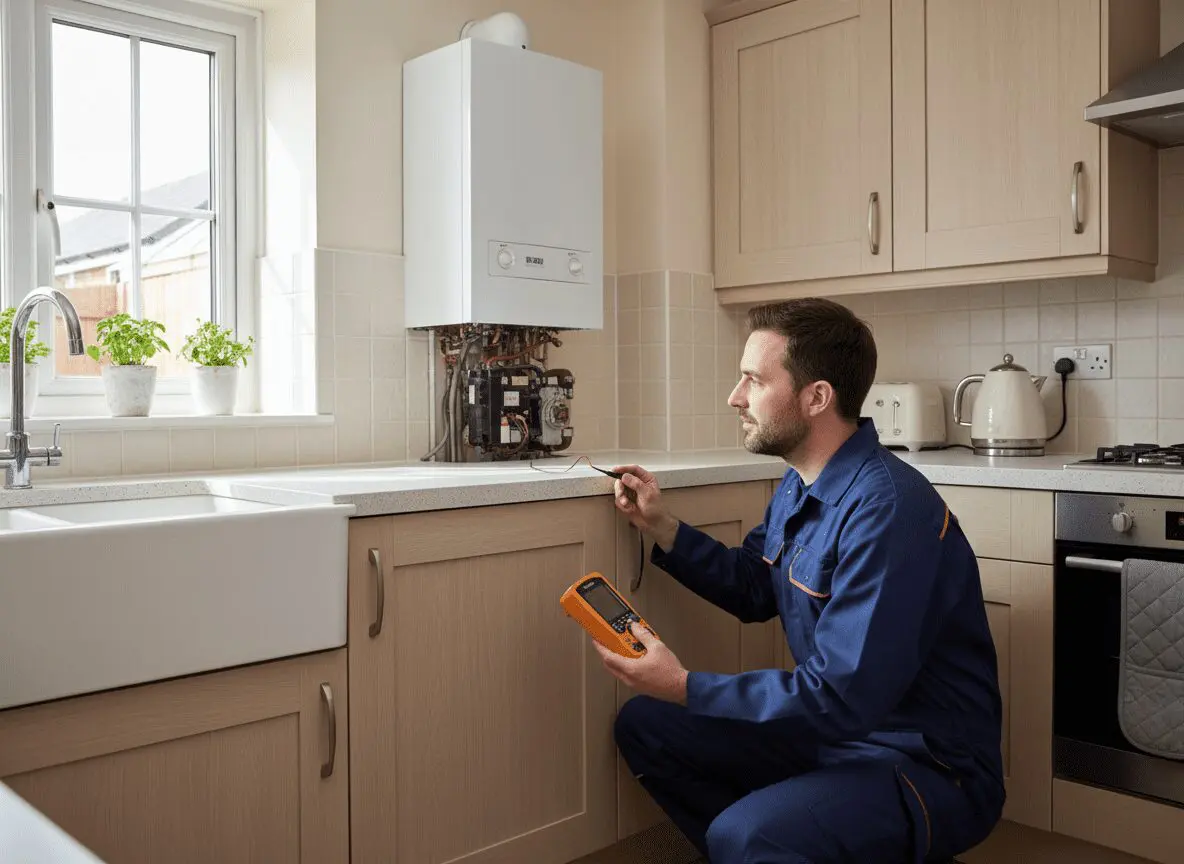
Most people know they should get their boiler serviced annually — but far fewer know what actually happens during one.
Understanding what a boiler service includes helps you see why it matters, what to expect on the day, and why skipping it can cost a lot more in the long run.
In this guide
- Why a boiler service matters
- What a boiler service includes — the full checklist
- How long does a boiler service take?
- What the engineer tells you afterwards
- Signs your boiler might fail its service
- How often should you have a boiler service?
- What a boiler service doesn’t include
- Book your boiler service in Sheffield
Why a boiler service matters
A boiler service is not just a box-ticking exercise. It is the main way to catch small faults before they become expensive breakdowns — and the main way to make sure your boiler is operating safely.
A poorly maintained boiler can develop carbon monoxide leaks, dangerous pressure faults, or gas supply problems — none of which are obvious until something goes wrong. A Gas Safe registered engineer is trained to spot these issues before they become a safety risk.
Most boiler manufacturers also make annual servicing a condition of their warranty. Skipping a service can leave you without cover if the boiler breaks down and the manufacturer finds it was not maintained.
Key point
A boiler service should always be carried out by a Gas Safe registered engineer. This is a legal requirement in the UK — not just a best practice recommendation. You can check whether your engineer is registered at gassaferegister.co.uk.
What a boiler service includes — the full checklist
The exact checks will vary slightly depending on your boiler make and model, but a standard annual boiler service in the UK covers the following.
Visual inspection of the boiler and surroundings
The engineer starts with a visual inspection. They check the boiler casing for signs of damage, corrosion, or leaks. They also look at the pipework connected to the boiler — checking for corrosion, joint integrity, and signs of past water damage. The area around the boiler is checked to ensure nothing flammable or obstructive is nearby.
Flue and combustion check
The flue is the pipe that takes waste gases from the boiler out of your home. The engineer checks the flue is correctly fitted, properly sealed, and not blocked. They then run a combustion analysis — measuring the gases the boiler produces when it fires. This tells them whether the boiler is burning gas efficiently and safely. Poor combustion can indicate a fault with the burner or heat exchanger.
Gas pressure and flow test
The engineer checks the gas pressure both at the meter and at the boiler inlet to confirm the boiler is receiving the correct supply. Low gas pressure can cause the boiler to underperform or fail to ignite. If pressure is low, the issue may be with the gas supply line or an internal component.
Internal components check
The boiler casing is opened so the engineer can inspect the key internal parts. These typically include:
- Heat exchanger — checked for signs of damage, cracking, or soot build-up
- Burner — inspected and cleaned if needed
- Spark electrode or ignition — checked for wear and correct gap
- Seals and gaskets — checked for deterioration
- Fan and air intake — checked for correct operation and blockages
- Condensate trap and pipe — cleaned and checked (on condensing boilers)
If components show signs of wear, the engineer will advise whether cleaning, adjustment, or replacement is needed.
Controls and thermostat check
The engineer tests the controls that operate your boiler — including the thermostat, programmer, and any smart controls. They check that the boiler responds correctly when temperature demands change and that it cycles on and off as intended.
Safety devices test
Modern boilers have multiple built-in safety devices designed to shut the boiler down if something goes wrong. These include the overheat thermostat, pressure relief valve, and flame detection sensor. The engineer tests each safety device to confirm it activates when required.
System pressure check
The engineer checks the boiler’s system pressure on the pressure gauge. Most systems should operate between 1.0 and 1.5 bar when cold. Low pressure can indicate a leak or failed expansion vessel. High pressure can put the system under stress.
Quick summary — what gets checked
- Boiler casing and surrounding pipework
- Flue condition and combustion gases
- Gas pressure and flow rate
- Heat exchanger, burner, and ignition
- Seals, fan, and condensate trap
- Thermostat and controls
- All safety devices
- System pressure
How long does a boiler service take?
A standard boiler service typically takes between 30 minutes and one hour. The exact time depends on the age of the boiler, the make and model, and whether the engineer finds anything that needs attention.
Older boilers or those that have not been serviced recently may take longer if the engineer needs to clean components or investigate a fault. If a repair is identified during the service, that will be a separate job and additional cost.
You should be home during the service, as the engineer will need access to the boiler and may need to check your radiators or pipework as part of their assessment.
What the engineer tells you afterwards
At the end of a boiler service, the engineer will give you a verbal and written summary of the findings. This typically includes:
- Whether the boiler passed or failed on safety grounds
- The results of the combustion analysis
- Any components that need monitoring or replacement
- Recommendations for improving efficiency or system performance
- Whether the boiler is considered safe to continue operating
A good engineer will take the time to explain what they found in plain English — not just hand you a report and leave. If anything concerns you, ask questions on the day.
If a fault is found that makes the boiler unsafe to operate, a Gas Safe engineer has a duty to advise you and, in serious cases, may need to disconnect the appliance. This is rare, but it is one more reason why regular servicing is important — catching faults before they reach that stage.
Signs your boiler might fail its service
If your boiler has been showing any of the following before its service, make sure to mention it to the engineer. These are the issues most likely to flag up during checks:
- Unusual noises — banging, kettling, or gurgling sounds when the boiler fires up
- Yellow or orange flame instead of a blue flame (visible on older open-flue boilers)
- Boiler cutting out repeatedly or failing to fire first time
- Pressure dropping frequently between top-ups
- A smell of gas or burning near the boiler
- Radiators taking longer to heat up than usual
- Higher than expected gas bills without a clear reason
If you smell gas
Do not wait for a service. Turn off the gas supply at the meter, open windows, and call the National Gas Emergency Service on 0800 111 999 immediately. Do not use any electrical switches or appliances until the property has been checked.
How often should you have a boiler service?
The standard recommendation is once a year. Most manufacturers specify annual servicing as a condition of warranty, and most engineers recommend a service before the colder months — typically between August and October — so the boiler is in good shape when heating demand increases.
Landlords have a legal obligation to have gas appliances — including boilers — checked annually by a Gas Safe registered engineer and to provide tenants with a valid Gas Safety Record. This is separate from but often done at the same time as a boiler service.
If your boiler is older than 10–12 years, more frequent checks may be advisable. Older boilers can develop faults more quickly between services, and it is worth knowing the condition of key components so you can plan ahead.
What a boiler service doesn’t include
It’s useful to know what a standard boiler service does not cover, so there are no surprises:
- Repairs to faulty components — if a part needs replacing, this is priced and agreed separately
- Power flushing — clearing sludge from the system is a separate service
- Radiator bleeding or balancing — again, a separate job if needed
- Leak detection or pipework repairs — a service checks for signs of issues but does not include repair work
- Replacement of the boiler — if the engineer recommends a new boiler, that is a separate quote
Some heating engineers offer combined service and repair plans that bundle annual servicing with a set number of call-outs per year. If your boiler is older or has a history of faults, it is worth asking whether a plan makes sense for your situation.
Book your boiler service in Sheffield
Heat365 carries out boiler services across Sheffield and the surrounding areas including Rotherham, Barnsley, Doncaster, Chesterfield, and Worksop. All our engineers are Gas Safe registered, and we work on all major boiler makes and models.
We recommend booking before the autumn rush — once the heating season starts, availability fills up quickly. If your boiler has not been serviced in the last 12 months, now is a good time to get it sorted.
You can find full details on our boiler servicing page, or get in touch directly to arrange a time that suits you.
Frequently asked questions
Do I need to be home during a boiler service?
Yes. The engineer will need access to the boiler and may need to check radiators or pipework in other parts of the property. You’ll also need to be available to discuss any findings at the end of the visit.
What happens if my boiler fails its service?
If the engineer finds a safety issue, they will explain what the fault is and what needs to be done. In serious cases, they may need to advise against using the boiler until it is repaired. You should not ignore this advice — operating an unsafe boiler is a risk to everyone in the property.
Can I service my own boiler?
No. A boiler service must be carried out by a Gas Safe registered engineer. It is illegal in the UK to carry out gas work — including a boiler service — without being registered. DIY attempts can invalidate your warranty and create serious safety risks.
How much does a boiler service cost in Sheffield?
Costs vary depending on the boiler make, model, and engineer, but a standard annual service typically falls in the range of £60–£120. Contact Heat365 for a current price for your property.
Is a boiler service the same as a gas safety check?
Not exactly. A gas safety check (CP12) is a legally required check for landlords and covers all gas appliances in a property. A boiler service is a more detailed inspection of the boiler specifically. Landlords often have both done at the same appointment.